
You're drifting along a Cozumel wall, a fish flashes past in the blue, and for a second you know it's something good, but the color disappears before your brain can lock onto a name. That's a common problem with tropical fish identification underwater. The fish never pose for a clean textbook view, and the reef rarely gives you more than a few seconds to read the right clues.
The divers who get better at it stop chasing color first. They watch shape, fins, mouth position, behavior, and where the fish is living, then they confirm the match later against a reliable field guide or database. On Cozumel reefs, that habit makes the difference between a vague “pretty yellow fish” and a usable ID you can trust.
Table of Contents
- Why Color Alone Fails Underwater
- The Morphology-First Identification Workflow
- Underwater Photography and Field Notes That Help
- Digital Tools and Apps for Post-Dive Verification
- Common Cozumel Reef Fish to Practice Identification
- Building Your Identification Skills Across Multiple Dives
Why Color Alone Fails Underwater
A diver points at a reef fish and says, “That one was bright blue,” but by the time the question comes up on the boat, the fish has already turned into a blur of guesses. I've seen that happen on calm Cozumel drifts, on murkier days, and on bright snorkel runs where glare turns every surface into a mirror. Color feels obvious in the moment, but underwater it's one of the least stable clues you can lean on.
The reef changes what your eyes think they see
Light falls off fast with depth, and water changes the way red, orange, and yellow read to the human eye. Add distance, motion, and the angle of the sun, and two divers can describe the same fish very differently. A juvenile can also look nothing like the adult you saw on a chart, which is one reason a quick color match often sends beginners to the wrong species.
That's why a field-first approach stays focused on features that hold up when the lighting doesn't. Body shape, mouth position, fin placement, and tail shape are easier to compare across bad angles and moving water. The fish may not stay still, but its structure stays far more consistent than its apparent brightness.
Practical rule: if color is the first and only clue, you're probably guessing.
A better habit is to use color as a supporting detail after you've noticed the silhouette and the fish's general profile. That's how guides and instructors keep pace with real sightings, and it's the same mindset behind the Cozumel diving guide when conditions aren't perfect. On a reef, the fish that looks “unusual” usually stands out because of shape or behavior before its pattern makes sense.
The Morphology-First Identification Workflow
A fish that flashes past in bad light gives you only a few useful clues. That is why expert identification starts with the outside of the fish, not with an app and not with a color guess that may fall apart the moment the animal turns. FAO guidance recommends checking the specimen's main diagnostic characters, confirming that the species is recorded from the capture area, then validating the current accepted name in FishBase or Catalog of Fishes FAO guidance. That sequence matters because a wrong first assumption sends the search in the wrong direction.
What to look at first in a 10-second sighting
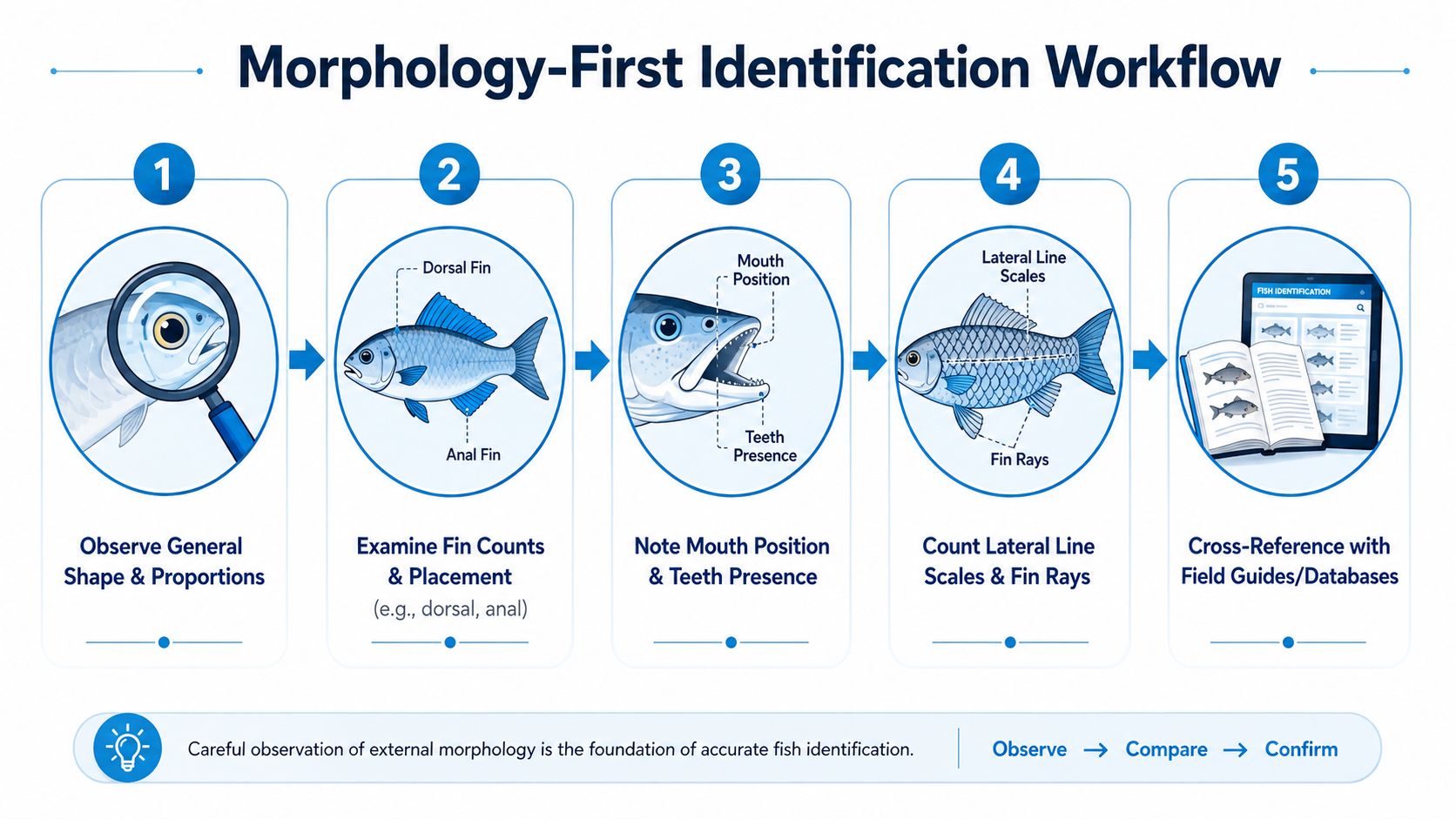
Start with overall body shape. Is the fish oval, elongated, deep-bodied, flat, or laterally compressed? Then look at fin placement and structure, especially the dorsal, pelvic, and caudal fins, because those features fit the standard morphometric and meristic approach used in training materials for species identification. After that, check the mouth. Is it small, upturned, beak-like, or set low on the head? If the fish holds position long enough, glance at scale pattern, lateral line, and tail shape.
A fast order of operations helps when the fish keeps moving.
- Silhouette first. Read the body outline before the pattern.
- Fins second. Note dorsal height, fin position, and tail shape.
- Head third. Mouth position and snout shape often separate similar species.
- Context last. Habitat, depth, and reef zone narrow the list further.
Why range checks matter as much as shape
A fish can match the right body plan and still be the wrong species for the place you saw it. Range and habitat checks belong in the workflow, not after it. FishBase serves as a broad reference for species records and identification keys, which is useful because tropical reefs hold many close lookalikes FishBase. That breadth matters in practice, because a local species often gets confused with a similar fish from another region when a diver tries to identify it from memory.
Fish names also vary by language and region, so casual ID discussions can get messy fast. A guide, a visitor, and a database may all use different common names for the same tropical fish, which is another reason the morphology check comes first. FishBase lists a very large set of common names across many languages, and that variety shows how much naming can drift from place to place FishBase.
The best short list is the one you can defend with body shape, fin structure, and location.
That is the discipline behind reliable tropical fish identification. You do not need to name everything instantly. You need to narrow the field fast enough to avoid a bad guess.
Underwater Photography and Field Notes That Help
A blurry photo feels useful until you try to identify the fish later and realize the one thing you needed, the fin edge or mouth shape, is smeared out. Underwater images help most when they preserve the diagnostic parts, not just the prettiest angle. That means using the camera as an observation tool, not a souvenir machine.
What a usable fish photo looks like
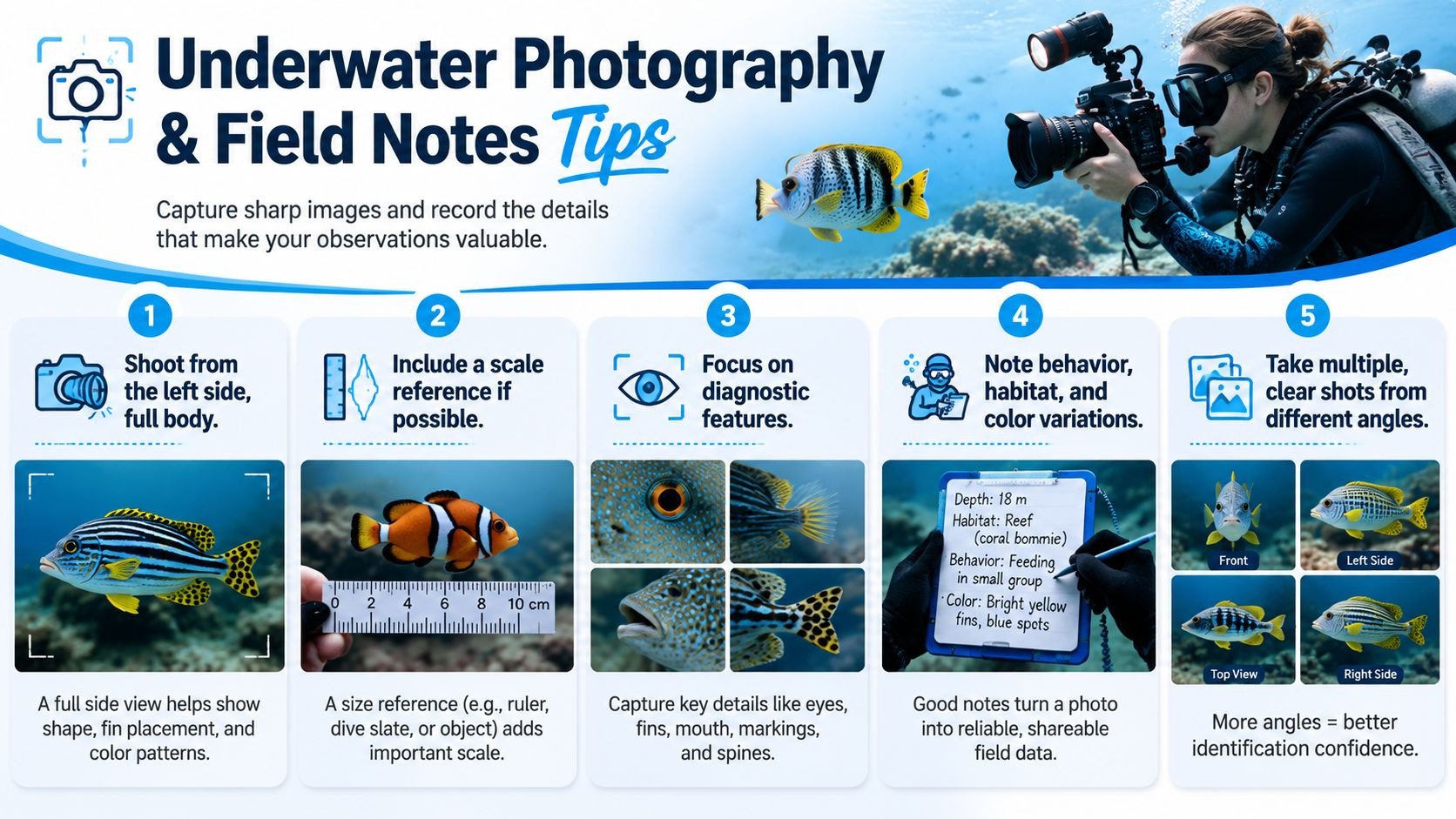
Published image-based identification frameworks emphasize a preprocessing-to-classification pipeline, but the upstream problem is the photo itself. Live-specimen images should ideally be taken from the left side, with a scale reference if possible, at high resolution so subtle color and shape cues survive review CMFRI training manual. Poor angle, glare, and missing scale are common failure points, and I see all three ruin otherwise good sightings.
A simple shot list works better than trying to get one perfect frame:
- Full-body profile. Capture the fish from head to tail.
- Fin details. Try one image where the dorsal and tail are clear.
- Head and mouth. A close view can settle a split between lookalikes.
- Environment. Include reef structure or sand if habitat matters.
The same logic shows up in broader wildlife work too. If you want a plain-language reminder of why clean framing matters, the wildlife photography guide is useful because the basics of composition, focus, and subject separation carry over well underwater.
Notes matter when the fish won't stay put
A camera won't tell you how the fish behaved unless you record it. Write down whether it was hovering above coral, grazing algae, hiding under a ledge, or schooling in open water. Habitat, depth, and neighboring species can be the clue that turns an uncertain photo into a credible match later.
I've found that the fastest note-taking habit is to write three things right after the sighting, before the next descent or boat move interrupts memory:
Behavior, depth, and one standout feature. That trio usually beats a vague color note.
If the fish was gone before you got a shot, a quick sketch or a few words still help. For snorkelers and new divers, a short written record often matters more than trying to remember a dozen color details after the dive.
Digital Tools and Apps for Post-Dive Verification
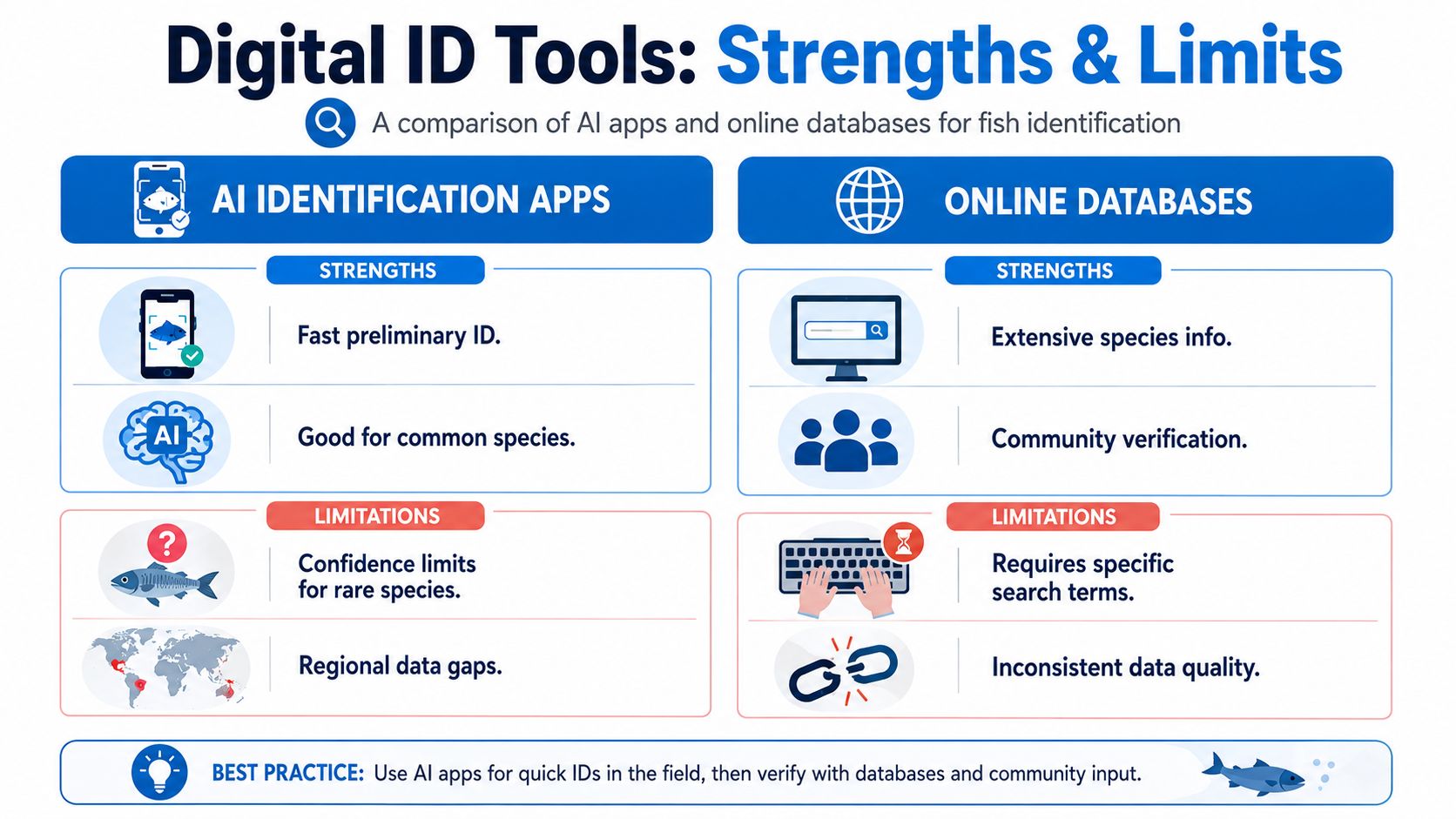
A good app can save time after the dive, especially when the fish was moving fast, the light was poor, or the photo only caught part of the body. It should narrow the possibilities, not pretend to finish the job. Recent tropical fish identification work in unconstrained environments uses transfer learning and computer vision, which shows the field is moving toward AI-assisted recognition rather than purely manual field guides Springer research. That helps, but the final call still belongs to the diver who checks distribution, morphology, and whether the name fits the fish in front of them.
Where apps help and where they stumble
Image recognition works best with common species and a clean, well-framed photo. It becomes much less reliable when the fish is rare, the light is weak, the angle is poor, or the animal was only visible for a few seconds through moving water. Anyone who has spent time on a boat knows the pattern, the first guess is easy, the hard part is deciding whether that guess fits the reef, the habitat, and the species range.
FAO guidance makes that point clearly in practice, even if the wording is technical, final identification should be checked against diagnostic characters and range data FAO guidance. Use apps as candidate generators, not verdict machines. If an app gives you three likely species, verify fin structure, body shape, and the species' recorded area before you accept any one of them.
FishBase is useful for that second pass because it gives you a broad reference point for species records, common names, and identification support. That matters when a local dive-boat name does not match the scientific record, or when you need to compare a photo against a wider species list without guessing from color alone. Use FishBase as the follow-up reference, not the first and only answer.
A practical workflow that keeps you honest
After the dive, sort the clearest photo first. If you have more than one angle, start with the image that shows the body outline, fins, and tail most clearly, since those details usually hold up better than color in mixed reef light.
Then run the app and compare its short list against what you saw. Check the range, compare the anatomy, and look for the features that stay consistent across angles, mouth shape, fin position, body depth, and tail form. If the evidence is thin, leave the ID open instead of forcing a neat label onto a weak image.
One post-processing step can make the review easier. If you are organizing dive photos for comparison, affordable background removal tools can help isolate the fish against a cleaner field, which makes the body shape and fin lines easier to inspect after the trip.
For operators and instructors, digital tools also support post-dive review boards, reef briefing cards, and species checklists built for one site rather than a generic tropical list. That is where they do real work, they reduce uncertainty without pretending the answer is automatic.
Common Cozumel Reef Fish to Practice Identification
A useful practice list should match what shows up on Cozumel reefs, not a field guide that looks thorough on land and falls apart when a fish darts past in mixed light. The goal is to recognize species that are common, visible, and distinctive enough to read in a few seconds. On guided dives, those are the fish that build pattern recognition fastest.
Quick-Reference Cozumel Fish Checklist
| Species | Key Field Mark | Typical Depth | Behavior |
|---|---|---|---|
| Sergeant Major | Bold black stripes and yellow upper body | Shallow reef zones | Schools and investigates divers |
| Queen Angelfish | Tall, disk-shaped body | Reef structure areas | Moves gracefully near coral heads |
| Doctorfish | Oval body and tail spine | Reef edges | Cruises in small groups |
| Foureye Butterflyfish | Eye stripe and false eye near tail | Coral-rich zones | Picks near coral surfaces |
| Blue Chromis | Small, bright blue schooling fish | Above coral heads | Schools tightly |
| French Grunt | Yellow striping on silver body | Reef slopes | Schools over reef and rubble |
| Schoolmaster Snapper | Reddish-silver body with yellow fins | Reef and ledges | Hovers in groups |
| Blue Parrotfish | Strong blue body and beak-like mouth | Reef slopes | Grazes coral and algae |
| Rainbow Wrasse | Slim body with shifting color bands | Shallow reef | Active, fast-moving |
| Longspine Squirrelfish | Red body and large eyes | Crevices and low light | Rests in shaded spots |
| Blackbar Soldierfish | Red body with black bar | Caves and ledges | Stays in groups under cover |
| Spotted Scorpionfish | Mottled, camouflaged body | Rocky or coral bottoms | Lies still and blends in |
| Queen Triggerfish | Deep body and bold pattern | Reef edges | Patrols and turns sideways |
| Smooth Trunkfish | Box-shaped body | Reef flats | Slow, deliberate swimmer |
| Balloonfish | Rounded body with spines | Sand and reef edges | Inflates when threatened |
How to use the checklist without overthinking it
Start with the fish that announce themselves. Sergeant Majors, Blue Chromis, and Queen Angelfish are easy enough to train your eye on shape and movement before you move to the species that rely on camouflage. That approach fits the kind of repetition you get on a PADI Open Water Diver – Private Training – Digital Manual Included course, where the value comes from seeing the same fish again and again under instructor supervision.
Behavior matters as much as markings for a few of these species. A Spotted Scorpionfish is identified as much by stillness and camouflage as by pattern, while a Blue Chromis is often easier to confirm by schooling behavior than by checking a single fish in isolation. Reef position helps too, because the site itself narrows the possibilities before you even settle on a name.
Use the best dive sites in Cozumel page to match your practice list to the reefs you visit. Different sites produce different fish, and the clearer your site-specific expectations are, the faster your eye learns what belongs where.
A note on training and repetition
A private skills course gives you repeated practice without the pressure of keeping up with a larger group. Scuba Life Cozumel also lists https://scubalifecozumel.rezdy.com/248608/padi-advanced-open-water-diver-private-training-digital-manual-included, which is a relevant option for divers who want to keep building observation skills while they continue their training.
Building Your Identification Skills Across Multiple Dives
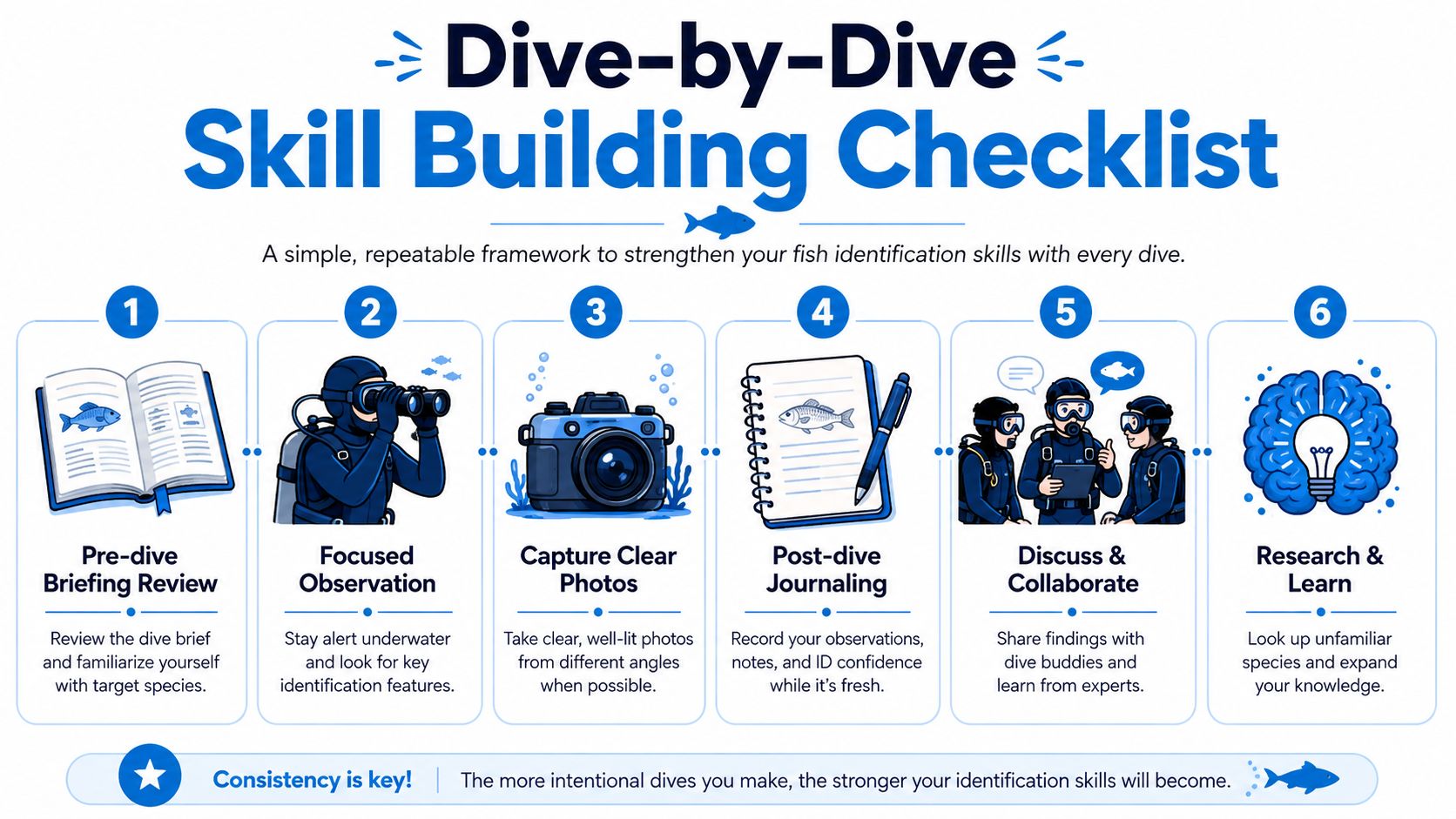
Fish identification gets easier when you stop expecting one dive to teach you everything. The divers who improve fastest build the same loop every time, brief, observe, photograph, verify, and log. That rhythm turns each reef sighting into a short lesson, and it is why experienced divers can see the same species in different conditions and still recognize it.
Make each dive a controlled practice round
Set one narrow goal before you enter the water. Three new species per dive is a better target than trying to name every fish you see. A small target keeps attention sharp and makes post-dive review useful, because you remember the features you were looking for instead of sorting through a long list of half-notes.
Use the dive team as part of the process. Guides, instructors, and buddy pairs often notice different details, and those differences help when a sighting is uncertain. Post-dive logging matters for the same reason, because patterns start to appear only after repeated exposure to the same species in different light, current, and depth.
A simple loop is enough:
- Review the briefing. Know which species are likely on that site.
- Observe with purpose. Watch body shape and fin structure first.
- Photograph the best angle. Keep the clearest profile you can get.
- Log the sighting. Write behavior, habitat, and your best candidate.
- Verify after the dive. Compare notes against the database later.
- Return with one question. Ask what feature you missed, not just what name was right.
Even uncertain sightings are useful if you record why you were uncertain.
A formal course can also support that habit. Structured instruction gives you repeated practice with feedback, and that matters when you are trying to build a reliable eye instead of guessing from color alone. The same approach also helps when you later read about larger animals, including sharks in Cozumel, because the habit of checking shape, behavior, and setting carries over from small reef fish to bigger sightings.
The long-term payoff is confidence, not perfection. Tropical fish identification stays probabilistic underwater, but repeated dives teach your eye what belongs together. Once that happens, the reef stops being a blur of color and starts becoming a readable set of shapes, habits, and signatures.
Scuba Life Cozumel runs guided dives, snorkeling trips, and PADI training that fit this kind of hands-on reef learning, so you can practice tropical fish identification where the fish live. If you want help turning quick sightings into confident IDs, visit Scuba Life Cozumel and plan a dive or snorkel outing that puts these skills to work on Cozumel's reefs.