
More than 1,500 divers may visit Cozumel's reef corridor each day, with many completing more than one dive, according to Cozumel National Marine Park. That pressure helps explain why the reef in Cozumel isn't a single, uniform attraction. It's a managed marine area where depth, current, coral condition, and protection zones shape what you'll see underwater.
The practical lesson is simple. A first-time snorkeler shouldn't choose a site for the same reasons an experienced wall diver does, and a diver shouldn't assume that every protected reef offers the same habitat or conditions. The most rewarding trips start with a clear match between the site, the day's conditions, your certification, and the kind of reef experience you want.
Table of Contents
- Understanding the Cozumel Reef Ecosystem
- Coral Health and Reef Recovery Trends
- Signature Marine Life by Depth Zone
- Comparing Dive and Snorkel Site Characteristics
- Seasonal Conditions and Visibility Planning
- Marine Park Rules and Safety Essentials
- Getting the Most from Guided Reef Experiences
Understanding the Cozumel Reef Ecosystem
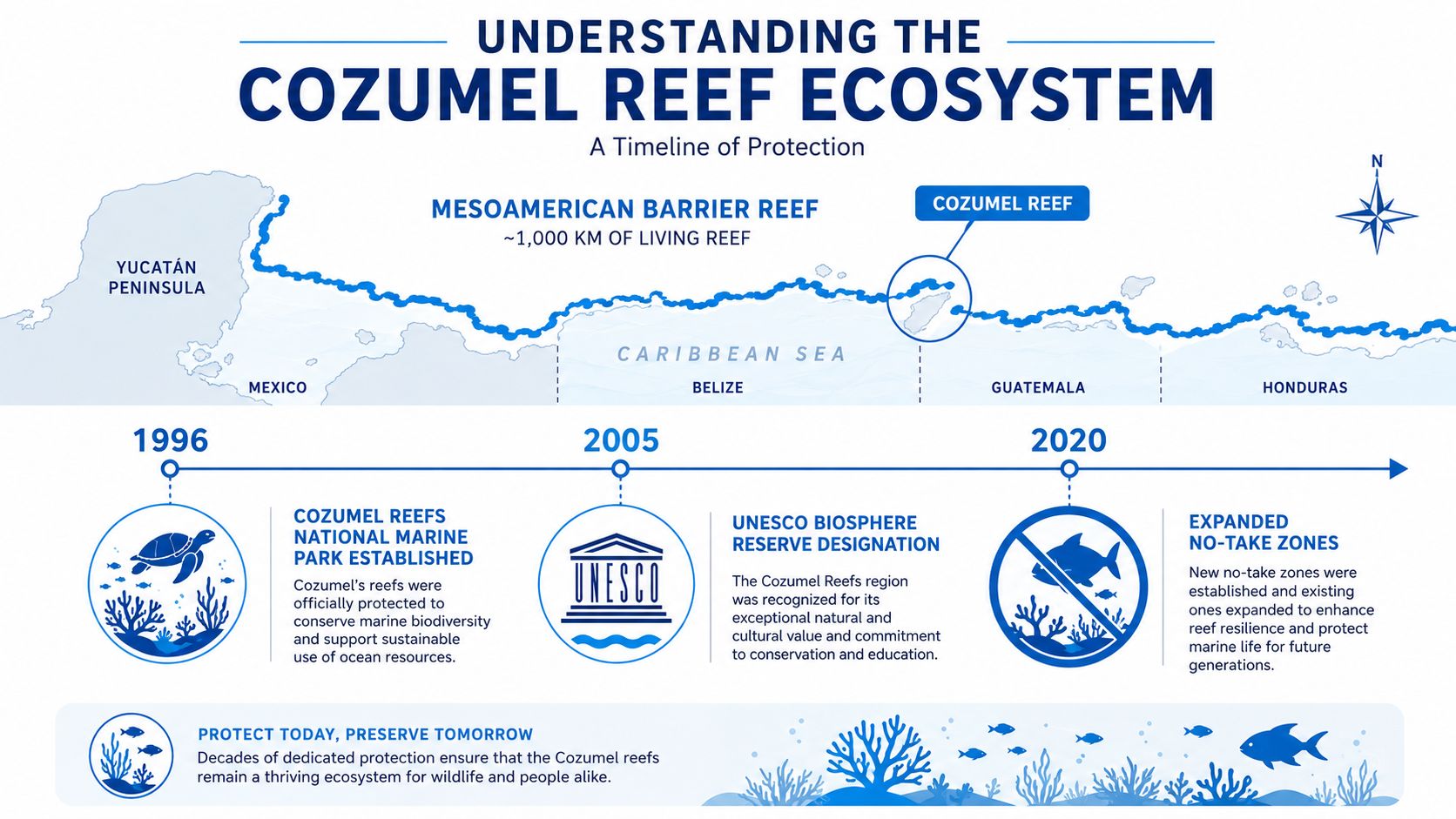
Cozumel's reefs belong to the northern Mesoamerican Reef, the wider system recognized as the world's second-largest reef system. For divers, the island's western coast matters most. It contains the protected marine park, a long reef corridor, and the walls and slopes that create Cozumel's distinctive drift dives.
Protection developed in stages. Mexico established an initial refuge zone for marine flora and fauna along the western coast in 1980, then formally created the Parque Marino Nacional Arrecifes de Cozumel on July 19, 1996. The protected area covers 11,987.87 hectares, roughly 12,000 hectares, across marine-terrestrial space along the western coast, as documented by Mexico's National Commission of Natural Protected Areas.
That history affects how you select a dive. This is a managed conservation zone, not an unmanaged stretch of coral. Operational areas regulate boating, mooring, diving, snorkeling, and access, reducing physical damage while keeping the reef available for tourism.
Why the protected footprint changes your dive
The park received Ramsar recognition on February 2, 2005, confirming the area's international ecological importance. That status does not make every site pristine or give every reef zone identical conditions. It identifies valuable habitat that needs active management.
Park location influences boat approaches, mooring systems, route planning, and which activities fit a particular area. A shallow coral garden can suit a nervous snorkeler or a first-time diver. A deeper wall demands better buoyancy control, comfort with current, and disciplined gas planning. Depth stratification also changes the scenery. Shallow areas may offer easier observation and more ambient light, while deeper slopes and walls provide different structure and exposure to current.
Daily visitor pressure adds another variable. A busy site can feel completely different when several groups arrive together, even if visibility and current remain favorable. Experienced guides adjust timing, entry points, and route direction instead of treating a site name as a guarantee.
Practical rule: Choose the reef for the diver you are today, not the diver you hope to be by the end of the trip.
Cozumel's importance also comes from the wider system it supports. Mori Atlas' park summary describes the national park as part of the Mesoamerican Reef and associates the broader region with 1,192 marine species and UNESCO recognition. For a diver, the useful point is habitat variety. Different depths, reef structures, and management areas produce different encounters, so site choice should match your training, comfort, and the conditions on the day.
Coral Health and Reef Recovery Trends
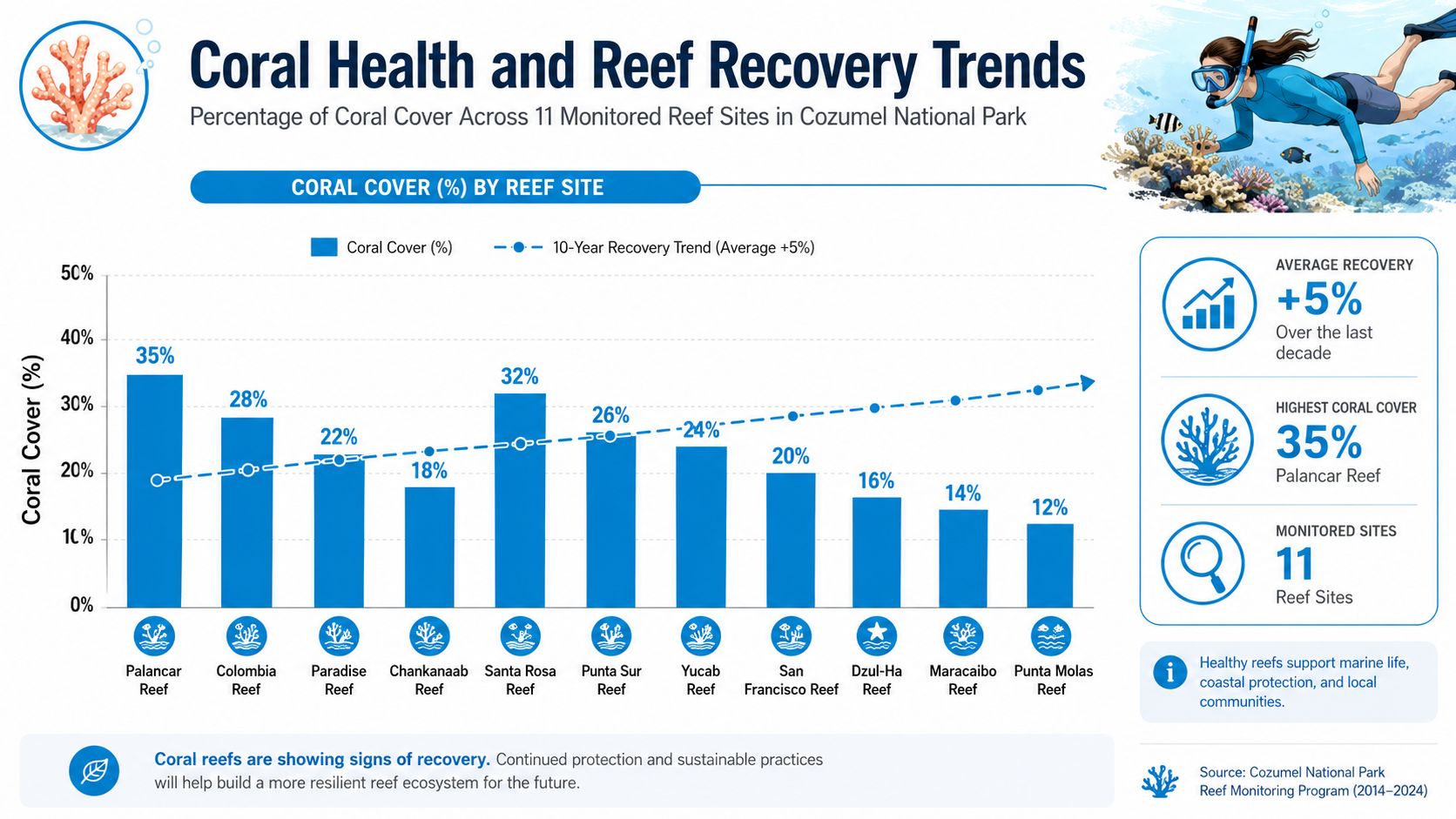
A protected reef can still show stress, recovery, and uneven coral development from site to site. Long-term monitoring of 11 reefs across protected areas found that Cozumel National Park sites showed an increase in live coral cover, along with high richness, diversity, and evenness, according to the Scientific Marine monitoring study.
The strongest gains involved Porites species and Agaricia species. That finding gives divers a more useful way to read the reef than just asking whether a site looks “healthy.” A reef may be recovering because living coral is expanding across available substrate, even if it doesn't yet have the dense, mature architecture shown in older photographs.
What recovery looks like underwater
A recovering reef can contain a mixture of living coral, exposed rock, older skeletons, algae-covered substrate, sponges, and scattered colonies. You may notice active growth without seeing the continuous coral blanket that people often expect from promotional images.
A stronger, more structurally complex site usually offers:
- More vertical relief: Coral formations create ledges, overhangs, and shelter for small fish.
- Mixed colony sizes: Different growth stages suggest ongoing recruitment and survival rather than one uniform generation.
- Diverse surfaces: Coral, sponge, rock, and sand support different organisms and feeding strategies.
- Active fish use: Fish moving through crevices and around coral heads indicate that structure is functioning as habitat.
These observations aren't a substitute for scientific monitoring. They're a way to pay attention without reducing reef health to color alone. Bright coral can still exist in a site with limited structural complexity, while a quieter-looking area may show meaningful recovery.
Why site selection matters
The monitoring study's central operational lesson is that condition varies by reef and management zone. A dive operator shouldn't run the same route blindly every day. Guides should consider current exposure, diver ability, recent observations, and the type of benthic community expected at each site.
For first-timers, a site with manageable current and clear navigation may produce a better experience than a more dramatic wall. Experienced divers may prefer a route where recovering coral communities sit alongside complex formations and deeper habitat.
The reef in Cozumel is worth exploring with realistic expectations. Some sites will impress you through architecture, others through fish behavior, and others through evidence that coral communities are rebuilding over time.
Signature Marine Life by Depth Zone
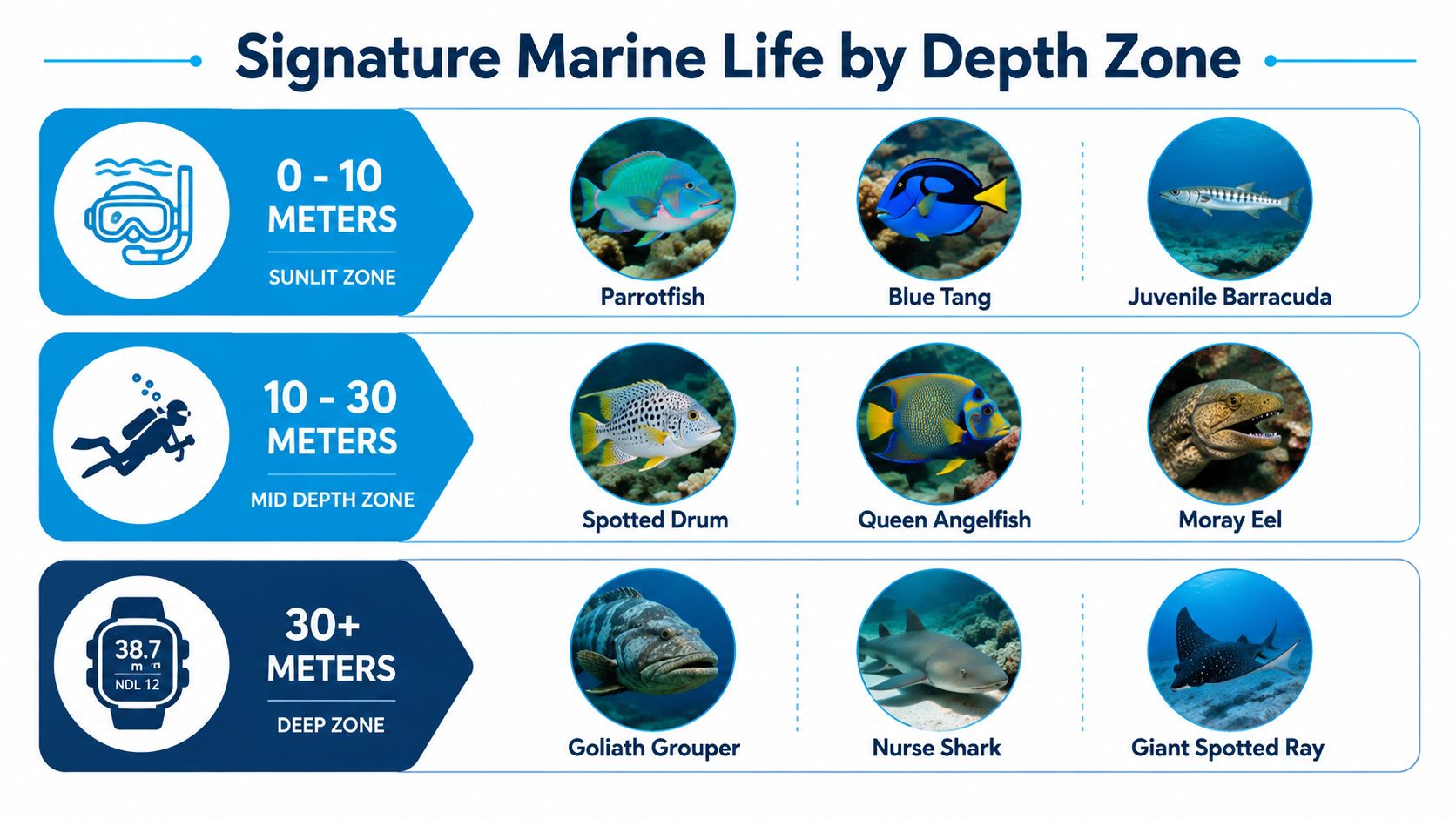
Depth changes the reef experience more than most first-time visitors expect. Cozumel's habitat extends beyond the shallow band used by snorkelers into deeper wall environments and mesophotic coral ecosystems, where benthic and fish communities have been quantitatively characterized in assessments of the island's protected waters, including the study of Cozumel's deeper reef ecosystems.
That depth structure affects visibility, fish assemblages, available light, and the way you plan the dive. It also means a shallow snorkel and a deep wall dive aren't lesser and greater versions of the same activity. They're different ecological experiences.
The shallow zone
Shallow coral gardens are the most accessible layer for snorkelers and newer divers. Light reaches the reef strongly, colors are easier to appreciate, and tropical fish often move across open coral heads and sandy edges.
Look for parrotfish, blue tang, juvenile barracuda, damselfish, and smaller reef residents using coral and seagrass as cover. The key skill here is controlled movement. A snorkeler who kicks hard or stands on the bottom can damage fragile habitat and stir sediment into the water.
For a visual refresher before your trip, use this tropical fish identification guide to learn the shapes and markings you're likely to encounter.
Mid-depth walls
Mid-depth sites introduce more relief. Walls, overhangs, and swim-throughs create shaded habitat, while the open blue beyond the edge can produce encounters with larger animals such as eagle rays and sea turtles.
The current may also feel more noticeable along a wall. Keep your guide in sight, maintain neutral buoyancy, and avoid chasing animals into open water. Your best sightings often happen when the group slows down and lets the reef reveal itself.
Deeper refuge habitat
Deeper mesophotic zones support fish and benthic communities that differ from those found in shallow gardens. These dives can offer a change in species composition and visual atmosphere, but they demand better preparation.
Before choosing a deeper route, confirm:
- Certification: Your training must match the planned depth and environment.
- Gas management: You need a conservative reserve and a clear turnaround plan.
- Buoyancy control: A wall leaves little room for correcting poor depth control.
- Current strategy: You should understand how the group will descend, drift, and ascend.
Deeper isn't automatically better. It's better only when the diver, equipment, conditions, and objective all match.
Comparing Dive and Snorkel Site Characteristics
Cozumel offers more than 35 named dive sites, according to Scuba Life Cozumel's operational information, but site names alone don't tell you whether a location suits your group. The useful distinctions are slope versus wall, sheltered water versus stronger current, and open coral gardens versus swim-through terrain.
Northern areas are generally associated with gentler slopes and coral gardens that can work well for relaxed exploration. Southern sites often deliver more dramatic walls and stronger current exposure. That contrast creates variety, but it also makes site selection a safety decision rather than a popularity contest.
| Site Type | Depth Range | Current | Best For | Marine Life Highlights |
|---|---|---|---|---|
| Shallow coral gardens | Shallow to moderate | Often manageable, conditions vary | Snorkelers, families, newer divers | Tropical reef fish, juvenile fish, coral colonies |
| Sloping reef | Moderate | Moderate to brisk depending on site | Certified divers building confidence | Parrotfish, angelfish, moray eels, turtles |
| Vertical wall | Moderate to deep | Can be brisk or strong | Experienced certified divers | Eagle rays, turtles, larger reef fish, wall communities |
| Swim-throughs and caverns | Moderate to deep | Varies within passages | Divers with strong buoyancy and situational awareness | Moray eels, sponges, shaded reef fish |
| Southern advanced sites | Deep and variable | Stronger exposure possible | Experienced divers comfortable with drift profiles | Pelagic sightings, rays, turtles, dramatic formations |
Match the landscape to your objective
If you're bringing a mixed group, shallow gardens can reduce the gap between snorkelers and divers. Snorkelers stay above the reef while divers explore the structure below, provided the operator selects a site where both activities are appropriate and safely supervised.
Walls deliver the strongest sense of scale. You can hover beside a vertical face, watch sponges and corals pass beneath you, and use the blue water as a second field of view. The trade-off is that depth and current can increase task loading, especially for divers who still struggle with buoyancy or air consumption.
Swim-throughs reward control, not courage. Enter only when the briefing covers the route, exits, overhead limitations, and group procedures. A diver who is distracted by the scenery can easily lose depth, contact, or awareness of the exit.
The right site is the one that gives you room to enjoy the reef without spending the dive managing conditions beyond your comfort level.
Seasonal Conditions and Visibility Planning
Cozumel diving operates throughout the year, but the experience changes with wind, current, surface chop, light, and visitor traffic. The most useful planning approach isn't to search for one perfect month. It's to decide whether your priority is calm snorkeling, reliable boat operations, dramatic drift conditions, or flexibility when weather changes.
General travel sources describe warm water year-round, with colder conditions in winter and warmer water in summer, but exact temperatures and visibility vary by day. For current planning, consult a local operator's Cozumel diving guide close to your travel dates rather than relying on a fixed seasonal promise.
Plan for the activity first
Snorkelers usually benefit from calmer surface conditions. Wind can create chop that makes mask clearing, breathing, and staying with the group more tiring, even when underwater visibility remains good. If snorkeling is the main objective, prioritize a calm forecast and a morning departure when practical.
Divers may tolerate more movement on the surface, but current still affects entry timing, descent procedures, navigation, and gas consumption. Stronger flow can make a drift dive exhilarating for an experienced diver and stressful for someone still learning to manage position and breathing.
A useful decision framework looks like this:
- For first-time snorkelers: Choose calm conditions, a guided boat, and a shallow site with easy group control.
- For newer certified divers: Favor a clear briefing, moderate current, and a reef profile that doesn't demand deep gas planning.
- For experienced drift divers: Consider wall terrain and stronger flow when the operator confirms that conditions suit the group.
- For mixed groups: Choose a site where snorkel and dive routes can coexist without forcing either group into unsuitable water.
Choose the day's window carefully
Morning trips often provide a more comfortable start before wind and surface activity build, but conditions are never guaranteed. Afternoon dives can offer different light angles and may feel less congested at some sites, while changing wind or current can make the route less predictable.
The captain and guide should make the final call after checking the conditions. If they change the site, that isn't a failure of the trip. It's often evidence that the crew is prioritizing the actual reef and the divers in front of them over a fixed itinerary.
Travelers who build in flexibility generally get better results than those who insist on one famous site regardless of weather. Cozumel's reef system is varied enough that a well-chosen alternative can still deliver excellent coral structure, fish life, and drift diving.
Marine Park Rules and Safety Essentials
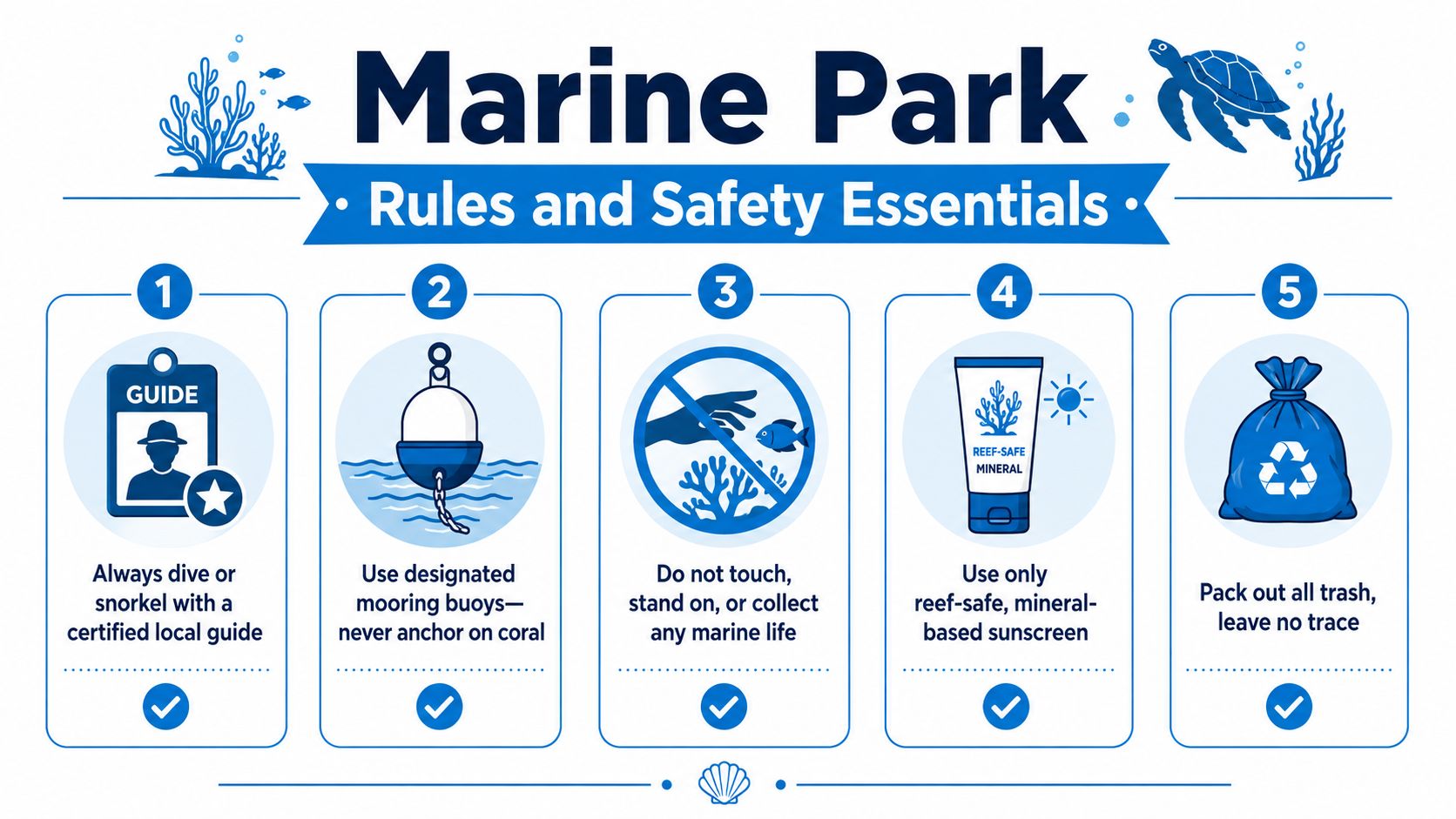
Marine park rules shape every dive on Cozumel's reef. Follow the guide, use designated moorings, keep your body and equipment away from coral, collect nothing, and take all waste back to shore. These requirements protect the habitat while keeping boats and divers from adding avoidable pressure to heavily visited sites.
Mooring buoys serve a practical purpose. Anchors can break or scrape coral, while an approved, maintained mooring keeps the boat secured without placing hardware on living reef. Confirm that the crew is attached to the correct buoy before entering the water.
Rules that protect the habitat
- Follow the guide: Local guides know site boundaries, current behavior, boat traffic, and routes that suit the group.
- Use mooring buoys: Boats should never anchor on coral. Ask the crew to confirm that the boat is secured to an approved mooring.
- Touch nothing: Watch coral, turtles, rays, fish, and sponges without contact. A fin, hand, or knee can damage living organisms, while standing on the bottom can destabilize loose substrate.
- Choose mineral sunscreen: Apply a reef-conscious, mineral-based product before entering the water. Restrictions on sunscreen help reduce chemical contamination around sensitive habitat.
- Pack out waste: Secure wrappers, batteries, plastic, and fishing line. Items dropped from a boat can remain in the marine environment long after the trip.
The Scuba Life Cozumel scuba diving safety tips offer further preparation guidance. The boat briefing still takes priority because the crew knows the selected site, depth zones, current, and traffic that day.
Your personal safety checklist
Certified divers should bring certification documentation, exposure protection suited to their comfort, a well-fitting mask, and a surface signaling device when appropriate. A camera can record the reef, but it must not distract you from depth, buoyancy, current, or your buddy's position.
Before entry, listen for the maximum depth, planned direction, expected current, separation procedure, and recall signal. Underwater, maintain a position that lets you respond to your buddy, check gas before it becomes a concern, and signal early if something feels wrong.
Snorkelers should wear the flotation equipment provided and tell the guide about nervousness, fatigue, or discomfort. Strong swimming ability does not remove the effects of current, boat traffic, or changing surface conditions. Staying with the group and keeping clear of coral protects both the swimmer and the reef.
Getting the Most from Guided Reef Experiences
A guide earns their value through decisions made before the boat leaves the dock. The useful question isn't whether a shop can name famous reefs. It's whether the team can match the site to your certification, comfort, objective, and the conditions that morning.
A local operator with knowledge spanning 35-plus named Cozumel dive sites, such as Scuba Life Cozumel, can adjust the plan when current, visibility, traffic, or diver readiness makes the original route a poor choice. That flexibility is particularly important in Cozumel because the reef's walls, slopes, swim-throughs, and deeper habitats place different demands on divers.
What first-timers need
Discover Scuba instruction works best when it treats anxiety as a training issue rather than a personality flaw. Confined-water practice gives a new participant time to become comfortable breathing through the regulator, clearing a mask, managing buoyancy, and communicating with an instructor before entering open water.
Close supervision also helps the instructor adjust the pace. A nervous participant may need more time at the surface, a simpler route, or a shorter objective. That's a better outcome than pushing someone into a site chosen for experienced divers.
What certified divers gain
Experienced divers often benefit from local judgment even when they're fully capable underwater. Guides can help select a wall for the day's current, avoid unsuitable exposure for a mixed group, and identify whether a site's structure is more interesting at a particular depth.
Private boat charters make sense for families and small groups with different goals. A group can combine snorkeling and scuba, request a customized reef itinerary, and avoid forcing every participant into the same depth or pace.
For visitors building a broader trip around the island and nearby destinations, central America itinerary tips can help place Cozumel within a larger regional plan. The diving itself still needs local scheduling, because flights, ferries, surface intervals, and weather can all affect what fits safely into a day.
PADI training is another practical route for travelers who want to leave with more than a single excursion. Scuba Life Cozumel lists PADI Open Water Diver, Private Training, Digital Manual Included as a catalog offering, while eLearning can help participants complete academic work before or during their stay.
Good logistics remove friction without removing responsibility. Equipment provision, resort dock pickup when available, onboard refreshments, and stay-and-dive coordination can simplify the day, but divers still need to disclose experience clearly, follow briefings, and respect their personal limits.
Scuba Life Cozumel offers guided scuba dives, shallow reef snorkeling, Discover Scuba instruction, PADI training, and private boat charters matched to different experience levels and reef objectives. Visit Scuba Life Cozumel to discuss current site conditions, choose an appropriate itinerary, and plan a safer, more informed experience on the reef in Cozumel.