From Checklist to Confidence: A Safer Dive Starts Here
You've got your bag packed, your mask is in the rinse bucket, and the boat day is close enough to feel real. Maybe you're heading to Cozumel for your first try-scuba experience, or maybe you're already certified and just want to keep your routine sharp. Either way, scuba diving safety tips only matter if they work in the moment, before you step off the boat, while you're descending, and when the reef is right in front of you.
Good safety habits don't kill the fun. They make the whole day smoother, calmer, and easier to enjoy. Recreational scuba diving is a low-frequency fatality activity across large populations, with one epidemiology study estimating about 1.8 deaths per million dives in the U.S. across 2006 to 2015, plus about 1,394 emergency-department presentations per year for scuba-related injuries (PubMed study). That doesn't mean risk disappears. It means careful habits really do change outcomes.
In Cozumel, that usually starts before you ever see the reef. A good dive team will brief the site, check the gear, match the dive plan to the group, and keep the pace controlled. That's especially important for beginners, because professionally guided entry-level experiences have seen stronger safety outcomes over time, with one review finding mortality in Discover Scuba Diving data fell from 2.55 deaths per 100,000 registrations to 0.87 per 100,000 registrations in the later period, a decline of more than 65% (PMC review).
The best scuba diving safety tips are simple, but they're not casual. They work because they're repeated every single dive day, not remembered only after something goes wrong.
Table of Contents
- 1. Complete Pre-Dive Equipment Check The ABCDE Rule
- 2. Proper Buoyancy Control and Weight Distribution
- 3. Never Dive Alone The Buddy System
- 4. Monitor Depth Time and Air Supply Continuously
- 5. Maintain Controlled Ascent Rates and Decompression Stops
- 6. Manage Nitrogen Narcosis at Depth
- 7. Equalize Ear and Sinus Pressure Regularly
- 8. Avoid Panic and Practice Emergency Procedures
- 9. Understand Your Physical and Mental Fitness for Diving
- 10. Plan and Communicate Your Dive Profile
- Top 10 Scuba Diving Safety Tips Comparison
- Your Next Safe Adventure Awaits in Cozumel
1. Complete Pre-Dive Equipment Check The ABCDE Rule
A fast, disciplined gear check catches the problems that matter before they reach the water. The ABCDE sequence, Air, Buoyancy, Clearance, Depth gauge, Emergency, gives you a simple mental order that works whether you're renting gear, using your own kit, or gearing up for a first supervised dive.
With rental equipment, the biggest mistake is assuming the last diver already found every issue. A regulator can breathe fine on the surface and still feel stiff under load, a BCD can inflate but leak slowly, and a hose routing problem can snag once you're moving. If you've never done a structured check before, pair it with your pre-dive setup every single time until it becomes automatic.
Practical rule: If you can't explain what each piece of gear is supposed to do before splash time, you're not ready to descend yet.
For a first-timer, this check should happen with the instructor's hands on the gear, not just your eyes. In a Discover Scuba setting, that means learning where the inflator is, how the regulator breathes, and how to confirm the tank and BCD are behaving as expected. For certified divers, it means doing the buddy check without rushing because the boat is waiting.
A solid land-side routine helps too. Practice the order before you step onto the dock, check that your air supply is adequate for the planned dive, and breathe from the regulator at the surface to spot resistance or water intrusion. A brief BCD hold test is worth the time, because a slow leak is easier to spot on land than at depth. If you're building your course knowledge before a trip, the PADI Open Water eLearning option is a useful place to review the basics before you arrive.
For visitors joining a midday try-scuba outing, the catalog item 2 PM – Discover Scuba Diving – 2 Boat Dives is listed as a boat-based experience. The important part is not the label, though. It's that the gear check happens before anyone leaves the dock, not after a problem has already started underwater.
2. Proper Buoyancy Control and Weight Distribution
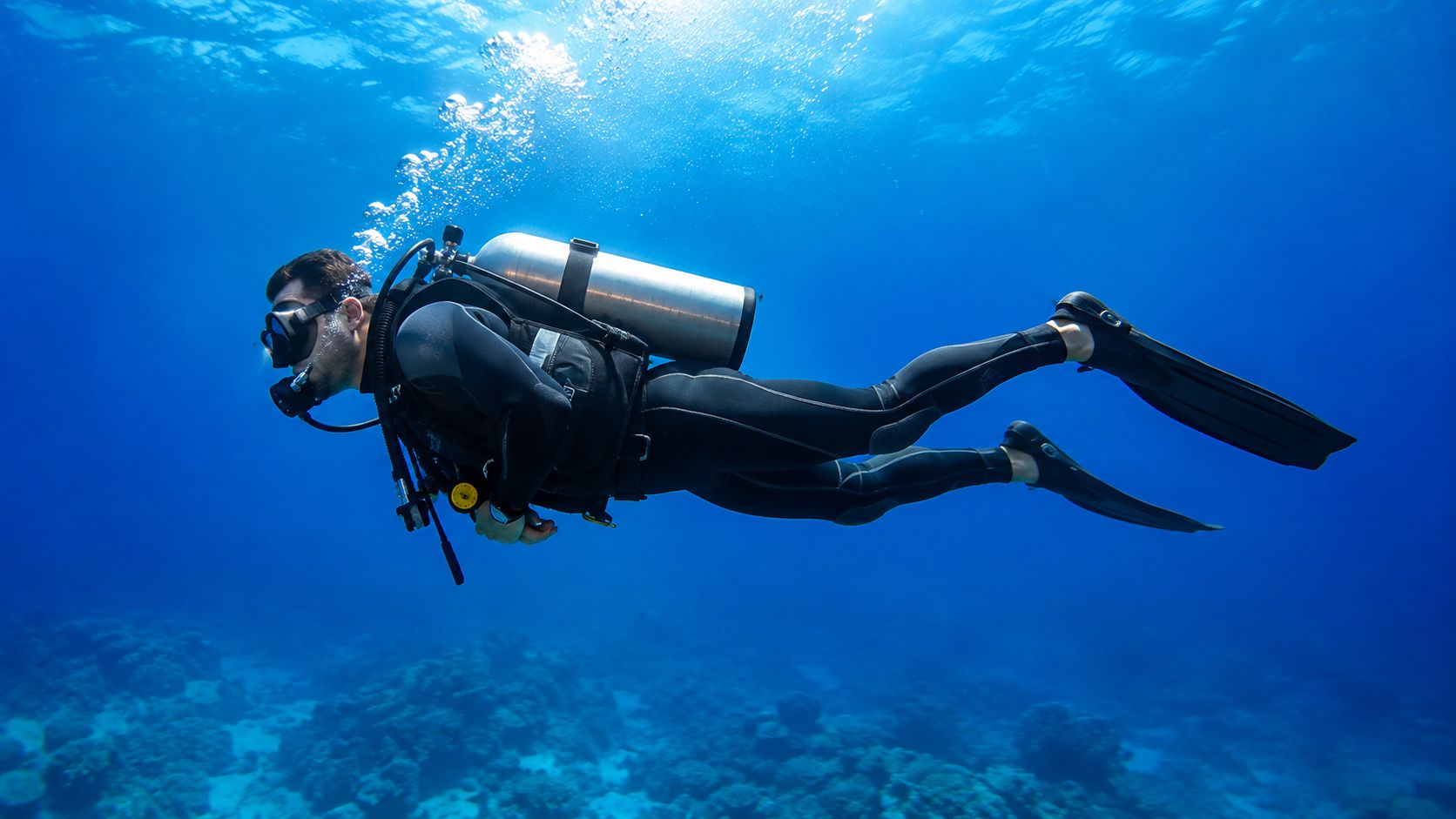
Good buoyancy is what makes diving feel controlled instead of busy. When you're neutrally buoyant, you stop fighting the water column, your breathing settles down, and you stop accidentally bumping the reef or drifting into your buddy's space.
A lot of new divers think buoyancy control means pumping the BCD constantly. It doesn't. The better habit is small corrections, a calm horizontal posture, and breathing that stays deliberate instead of shallow and frantic. If your weights are off, even the best breathing control won't fully compensate, so fit matters as much as technique.
For certified divers, the test comes once you leave the mooring line and settle into the actual dive. On Cozumel walls, good buoyancy is the difference between hovering cleanly in the current and bouncing up and down while trying to photograph a turtle. For Discover Scuba participants, the priority is simpler, stay stable enough to breathe comfortably and move without stirring sand or losing your position.
What works in the water
- Start slightly positive at the surface: Adjust gradually after you're stable, instead of overcorrecting before you've even begun.
- Use breathing before inflation: Small breath changes often do more than a BCD dump or full inflate.
- Stay horizontal when you can: Better trim spreads weight evenly and reduces drag.
- Recheck weighting after gear changes: A thicker exposure suit changes how much ballast you need.
- Test buoyancy early: Don't wait until the dive is half over to discover you're too light or too heavy.
This is also where local site knowledge matters. On guided two-tank boat dives in Cozumel, instructors and divemasters can spot whether a diver is fighting the water or moving with it. The goal isn't to look perfect. It's to stay stable enough that the dive feels calm, the reef stays untouched, and your air lasts longer because you're not working against your own position.
3. Never Dive Alone The Buddy System
The buddy system isn't just a tradition, it's your first layer of redundancy. A good buddy notices the small things you miss, like a drifting hose, a cloudy mask, an early breathing change, or a diver who's starting to rush.
That only works if the pair behaves like a pair. The best buddy teams agree on signals before the dive, stay close enough to help fast, and keep a shared idea of the plan from the start. In practice, that means checking each other's gear, confirming hand signals, and agreeing on what happens if one diver loses sight of the other.
On professional trips, the buddy system should fit the diver level. Discover Scuba participants are normally paired very tightly with an instructor, which is the right approach for someone learning how breathing, balance, and movement feel underwater for the first time. Certified guests on a two-tank boat dive should still treat the buddy as the primary emergency partner, even when a divemaster is nearby.
Stay close enough to help before the problem becomes a scramble.
A useful habit is to talk about the dive in plain language on the surface. Decide the hand signal for low air, the turnaround point, and the plan if you separate. If you're diving with people you don't know well, read the briefing carefully and confirm that you both understand the same limits. The best dive shops in Cozumel tend to make this part feel routine, because routine is what keeps it reliable.
The trade-off here is simple. A buddy system that's casual is barely a system at all. A buddy system that's clear, repeated, and respected becomes a genuine safety tool, especially in current, at depth, or when one diver is less experienced than the other.
4. Monitor Depth Time and Air Supply Continuously
Depth, time, and air are the three numbers that determine whether a dive stays easy or gets complicated. Once you stop watching them, the dive starts making decisions for you.
Certified divers need to treat gauge checks as a habit, not a reaction. That means checking depth, bottom time, and pressure often enough that you always know where you stand. For a newer diver, especially in a training or try-scuba setting, that monitoring is usually shared with the instructor, but it still helps to understand what the display is telling you.
The practical air reserve target from DAN's safe-diving guidance is 500 psi/35 bar remaining for a safety or decompression stop (DAN safe-diving practices). That benchmark matters because it builds in margin before the ascent, not after the tank is already getting low. If you're watching your pressure gauge regularly, you're far less likely to feel rushed when it's time to head up.
What to do before and during the dive
- Check your computer before entry: Know the buttons, the screen layout, and the warning indicators.
- Watch pressure often: Don't wait until you feel uncomfortable to look.
- Use a reserve plan: Decide your turning point before the dive starts.
- Move slowly when you can: Less exertion usually means better air management.
- Respect depth limits: Recreational diving has limits for a reason.
On guided Cozumel dives, divemasters help keep the group inside the plan, but they can't monitor your gauges for you every second. That's why experienced divers still build a rhythm of checking their own equipment. The diver who glances at the computer often usually has a calmer ascent, fewer surprises, and a better handle on how the dive is progressing.
For beginners, the lesson is even simpler. If the numbers are fuzzy, stop and read them. A diver who knows the depth, time, and remaining gas is in a much better position to make clean decisions than one who is guessing.
5. Maintain Controlled Ascent Rates and Decompression Stops
Ascending too fast is one of the easiest ways to turn a good dive into a risky one. Pressure drops quickly near the surface, and the ascent needs to stay controlled so your body can off-gas safely.
PADI identifies a maximum recreational ascent rate of 18 m/60 ft per minute and recommends a 3-minute safety stop at 5 m/15 ft (PADI golden rules). Those two numbers are worth memorizing because they're simple, practical, and easy to apply even when the dive is over and everyone is thinking about the boat ladder. The point is not to race the last few feet.
A good ascent starts before you leave the bottom. If your buoyancy is steady during the dive, the ascent feels smooth instead of jumpy. Small bursts of air from the BCD, a calm breathing pattern, and attention to your buddy all help you rise at a measured pace.
For two-tank boat diving in Cozumel, the safety stop is especially useful because it gives the group a shared pause before surfacing. That pause helps with buoyancy, communication, and spacing near the boat. It also makes the final moments of the dive feel less abrupt, which matters when people are excited or slightly tired.
If panic starts a rapid ascent, the response is still the same in principle, stop adding speed. Focus on breathing, dump unnecessary buoyancy, and regain control as soon as possible. The diver who practices slow ascents in shallow water usually handles this much better than someone who has only heard the rule once during class.
Safety stop habit: Don't treat the last few feet like a finish line. Treat them like part of the dive.
6. Manage Nitrogen Narcosis at Depth
Nitrogen narcosis is one of those risks that doesn't always announce itself clearly. A diver can feel oddly confident, distracted, amused, or slower to process simple tasks, and the deeper the dive goes, the more important it becomes to notice those changes early.
The practical fix is conservative depth discipline. On recreational dives, staying within the intended depth range helps keep narcosis from becoming a problem, especially when fatigue, cold, anxiety, or poor sleep are already in the mix. In Cozumel, wall dives often sit in ranges where experienced divers can stay comfortable, but comfort is not the same thing as immunity.
The tricky part is that narcosis can feel like confidence instead of confusion. That's why a buddy who knows you well is useful, because another diver may notice if your reactions seem slower or your decisions start getting sloppy. If symptoms show up, the right move is to ascend slowly to a shallower depth and reassess, not to push through it.
A few symptoms deserve attention right away. Numbness, tingling, euphoria, tunnel-like focus, or a sense that everything is oddly easy can all signal that depth is affecting judgment. That's not the moment to test yourself. It's the moment to get shallower.
Experience helps, but only up to a point. Deep diving training exists because depth changes the job, not because it makes the diver tougher. If you're on a guided dive in Cozumel and the profile starts getting ambitious for your current comfort level, the safest choice is usually the conservative one.
7. Equalize Ear and Sinus Pressure Regularly
Equalization should start before you feel pressure, not after. Once the squeeze begins, it's already telling you that the descent is moving faster than your ears or sinuses want to accept.
The best habit is early, frequent, gentle equalization. A lot of divers wait too long, then try to force the issue, and that's where trouble starts. If you're descending on a wall or following a guide down a slope, pause as soon as you feel resistance and equalize before continuing.
For Discover Scuba participants, this skill gets introduced in a controlled setting so the diver can practice without the extra stress of open water. For certified divers, the expectation is different, because frequent equalization should already be part of the descent routine. If you've got congestion, a bad cold, or allergy pressure, diving may not be the right call that day.
Safer equalization habits
- Pre-equalize at the surface: Start before the pressure builds.
- Equalize every few feet: Small, frequent adjustments are easier than one hard correction.
- Stop if it hurts: Pain is a signal to halt the descent.
- Never force pressure: Forced equalization can create more problems than it solves.
- Abort early if needed: A slow return to the surface is better than pushing through pain.
The trade-off is simple here too. A few seconds spent equalizing properly protects the dive, while forcing the descent can end the day. If equalization is repeatedly difficult, that's a reason to seek medical evaluation, not a reason to get stubborn underwater.
A calm descent also helps with everything else on the dive, because a diver who is not fighting ear pressure is freer to focus on buoyancy, navigation, and the buddy team. That's one of the reasons good briefings keep repeating the same advice. The habit is boring. The outcome is not.
8. Avoid Panic and Practice Emergency Procedures
Panic doesn't usually start big. It starts as fast breathing, a narrow focus, or the feeling that too many things need attention at once. If you catch it early, you can still turn the dive around safely.
That's why emergency skills need repetition, not just certification memory. Regulator recovery, out-of-air protocol, controlled ascents, and separation procedures become much more useful when the diver has practiced them enough that the steps feel familiar under stress. A calm diver has more options, and a rehearsed diver usually gets to those options faster.
In training, confined-water sessions are where those responses should become physical habits. A Discover Scuba student who practices mask clearing and regulator recovery in shallow water is much more likely to stay calm if a small issue appears later. Certified divers should refresh those skills from time to time instead of assuming muscle memory never fades.
If panic begins, stop the motion, breathe, and choose the single next action you can complete safely.
A strong dive team also lowers panic risk. Clear pre-dive communication, compatible buddy pairing, and conservative dive planning reduce the number of surprises the diver has to process. Fatigue matters too, because tired divers are often more reactive and less patient with small problems.
The most important trade-off is this, trying to “tough it out” underwater usually makes panic worse. Surfacing safely and resetting is always better than staying down while your thinking gets narrower. That principle is especially important for newer divers, but experienced divers need it just as much, because confidence can sometimes hide stress longer than it should.
9. Understand Your Physical and Mental Fitness for Diving
Diving asks your body and your mind to work together. If one of them is off, the whole dive can feel harder than it should.
Honest medical disclosure is part of the safety system, not a formality. Scuba Life Cozumel requires divers to complete a medical evaluation form, and any flagged condition calls for physician clearance before participation. That's the right standard because some health issues, medications, and recent illnesses can change how a diver responds underwater.
Pregnancy is treated differently under standard diving guidance, and many operators exclude pregnant divers. Other situations can still be manageable with the right medical advice, but only when the diver is being transparent and conservative about the risks. If you're unsure, the safe answer is to ask before the trip, not after you're already on the boat.
Mental fitness matters just as much. A diver who is exhausted, emotionally overwhelmed, or distracted by non-diving problems is more likely to miss signals, push past discomfort, or lose focus during a routine task. That's why sleep, hydration, and plain honesty with yourself are part of the dive plan.
A few practical checks help divers:
- Fill out medical forms truthfully: Don't minimize symptoms or medication use.
- Get clearance when required: If the form flags an issue, follow through.
- Avoid alcohol before diving: Give yourself enough time away from drinking.
- Don't dive while ill: Even minor congestion can affect pressure equalization.
- Be realistic about fatigue: If your head isn't in it, skip the dive.
If you're working on recovery or general conditioning, it can help to think like an athlete and respect the body's limits. A useful related read on that mindset is recovery methods for athletes. Diving isn't a race, and the diver who shows up rested and honest usually has the safest day.
10. Plan and Communicate Your Dive Profile
A dive profile is only useful if everyone involved understands it. That means depth, time, air reserve, turnaround point, and emergency plan all need to be clear before the descent begins.
On guided Cozumel trips, that briefing matters because site conditions change, current can shift, and different certification levels need different limits. A divemaster can shape the plan, but each diver still needs to know what the plan is. That includes how deep the dive is expected to go, when to turn, and what to do if conditions change halfway through.
The Cozumel diving guide is a useful way to think about local planning because Cozumel diving often depends on site choice, current, and the experience level of the group. A wall dive that feels easy for a seasoned diver may be a stretch for someone newer, and a good operator should account for that before the boat ever leaves.
Keep the plan simple and shared
- Set the maximum depth together: Don't assume everyone is thinking the same thing.
- Agree on the turnaround point: Use pressure, time, or both.
- Review the computer settings: Make sure your device matches the plan.
- Talk through contingencies: Separation, air issues, and changing conditions should not be improvisations.
- Log the dive afterward: The actual profile helps you improve the next one.
For training dives, the plan should be even more conservative, because the whole point is to build comfort and judgment. For certified divers, good planning is what keeps a familiar dive from becoming a careless one. A strong plan won't remove the surprises of the ocean, but it will make the responses less chaotic.
Top 10 Scuba Diving Safety Tips Comparison
| Safety Element | 🔄 Complexity (Implementation) | ⚡ Resources (Time / Equipment) | ⭐ Expected Outcomes | 💡 Ideal Use Cases | 📊 Key Advantages |
|---|---|---|---|---|---|
| Complete Pre-Dive Equipment Check (The ABCDE Rule) | 🔄 Moderate, 10–15 min per diver, systematic steps | ⚡ Low–Medium, checklist, SPG, BCD, regulators, instructor time | ⭐ High, prevents mid‑dive gear failures | 💡 All dives, rental gear, novice divers | 📊 Reduces failures; improves confidence and communication |
| Proper Buoyancy Control and Weight Distribution | 🔄 High, requires repeated practice and fine control | ⚡ Low, BCD, weights, practice time | ⭐ High, better air consumption and trim | 💡 Photographers, long dives, reef conservation sites | 📊 Extends bottom time; protects reef; reduces fatigue |
| Never Dive Alone, The Buddy System | 🔄 Low–Moderate, coordination and consistent briefings | ⚡ Low, paired divers, agreed signals | ⭐ High, immediate mutual assistance | 💡 Guided dives, inexperienced divers, family groups | 📊 Increased safety, accountability, and enjoyment |
| Monitor Depth, Time, and Air Supply Continuously | 🔄 Moderate, ongoing attention and calculations | ⚡ Medium, dive computer, SPG, training | ⭐ High, prevents DCS and out‑of‑air events | 💡 All dives, multi‑tank or deeper dives | 📊 Enables timely turnarounds; maximizes safe bottom time |
| Maintain Controlled Ascent Rates and Decompression Stops | 🔄 Moderate, requires buoyancy discipline and timing | ⚡ Low, dive computer, training time | ⭐ High, minimizes decompression risk | 💡 All recreational dives, repetitive dives | 📊 Reduces DCS incidence; safer surfacing procedures |
| Manage Nitrogen Narcosis at Depth | 🔄 Low, awareness and conservative depth limits | ⚡ Low, training, conservative planning | ⭐ Moderate, reduces impairment by limiting exposure | 💡 Deep recreational dives; PADI Deep course candidates | 📊 Prevents judgment impairment; enforces safe depth practices |
| Equalize Ear and Sinus Pressure Regularly | 🔄 Low, simple techniques but requires attention | ⚡ Low, practice and instruction | ⭐ High, prevents barotrauma and pain | 💡 All descents, especially rapid depth changes | 📊 Reduces ear/sinus injuries; improves descent comfort |
| Avoid Panic and Practice Emergency Procedures | 🔄 High, psychological prep and repetitive drills | ⚡ Medium, confined‑water drills, instructor time | ⭐ High, lowers panic‑related incidents | 💡 New divers, Rescue training, stressful conditions | 📊 Decreases leading cause of fatalities; creates automatic responses |
| Understand Your Physical and Mental Fitness for Diving | 🔄 Low–Moderate, honest medical screening & follow‑up | ⚡ Low, medical form, physician clearance if needed | ⭐ High, reduces health‑related incidents | 💡 All divers; anyone with medical history or meds | 📊 Prevents medical emergencies; protects diver/operator liability |
| Plan and Communicate Your Dive Profile | 🔄 Moderate, pre‑dive calculations and contingency planning | ⚡ Medium, dive computers/apps, briefing time | ⭐ High, prevents limit violations and confusion | 💡 Guided boat dives, multi‑dive days, mixed experience groups | 📊 Clarifies expectations; optimizes safety and dive enjoyment |
Your Next Safe Adventure Awaits in Cozumel
Safety isn't about shrinking the experience. It's what lets you enjoy the full dive without fighting avoidable problems. When you build these 10 scuba diving safety tips into your routine, you become easier to buddy with, easier to trust underwater, and far more capable of handling the small surprises that every real dive eventually brings.
That matters whether you're trying scuba for the first time or refining your certification-level habits. Recreational diving is statistically uncommon as a fatality activity across large populations, but the reason it stays that way is simple, divers and instructors keep applying the basics on every single dive, not only when they remember to. The gear check, buoyancy control, buddy discipline, gauge awareness, ascent control, and honest fitness check all work together.
Cozumel is a great place to practice that mindset because the dives can be beautiful, but they still ask for respect. If you're a beginner, a guided Discover Scuba experience gives you structure and close supervision. If you're certified, a well-run two-tank day lets you focus on clean habits, good communication, and the kind of calm repetition that makes strong divers even better.
Scuba Life Cozumel fits naturally into that kind of dive day because it's a PADI 5 Star dive center offering guided dives, Discover Scuba, and PADI training with eLearning support. That combination is useful for travelers who want the trip to stay organized while still keeping safety front and center.
If you're planning a Cozumel dive trip, choose the gear, training, and briefing quality that support these habits from the start. Visit Scuba Life Cozumel to explore guided dives, entry-level experiences, and PADI training options that can help you prepare for a safer day on the reef.