
You're probably planning Cozumel for the part that matters. Warm water, easy entries, bright reefs, and that first breath underwater that turns a vacation into a memory you'll keep for life. What you're probably not excited about is spending island time in a classroom while everyone else is already headed to the boat.
That's why PADI Open Water eLearning has become the smartest path for many new divers. You handle the academic side before you travel, then use your time in Cozumel for skill practice and actual diving. The catch is that the handoff between online study and in-water training is where many students get tripped up. They finish the theory, but forget to save the completion record, arrive with app issues, or realize too late that their timing created an avoidable delay.
This guide is built for that exact gap. It explains what PADI Open Water eLearning is, how the app works, what to bring, when to finish the theory, and how to keep your trip focused on the water instead of admin.
Table of Contents
- Your Cozumel Vacation Is for Diving Not Classrooms
- What Is PADI eLearning The Modern Way to Learn to Dive
- Key Benefits of the PADI eLearning Approach
- Your Step-by-Step eLearning Journey from Home
- From Online Theory to In-Water Training in Cozumel
- Investment and Inclusions What Your PADI Course Covers
- Your Next Steps to Become a Certified Diver in Cozumel
- Common Questions About PADI Open Water eLearning
Your Cozumel Vacation Is for Diving Not Classrooms
Most future students I talk to want the same thing. They want to land in Cozumel, settle into vacation mode, and get in the water as soon as possible. They don't want their first full day on the island spent flipping through manuals indoors.
That's the appeal of PADI Open Water eLearning. It moves the reading, videos, quizzes, and theory reviews into your normal life before the trip. You can study at home, on your commute, or during travel downtime, then arrive ready for the practical part.
A simple example helps. Say you've already been looking at Cozumel dive sites and picturing yourself over coral instead of in a chair. eLearning supports that goal because it shifts the academic work off your vacation schedule.
The vacation-time mistake most beginners make
New divers often assume certification starts when they reach the island. That used to be more common. Today, the efficient route is usually the opposite. Learn the theory first, then use destination time for pool or confined-water practice and open-water dives.
Practical rule: If your trip is short, protect your vacation hours by finishing the knowledge work before you pack.
What this changes in real life
Instead of arriving mentally overloaded, you show up already familiar with hand signals, basic equipment terms, pressure concepts, and what your instructor is asking you to do. That makes the in-water days feel smoother.
It also lowers stress. You're not trying to absorb safety concepts at the same time you're dealing with travel, hotel check-in, jet lag, and excitement about the ocean.
What Is PADI eLearning The Modern Way to Learn to Dive
PADI Open Water eLearning is the knowledge development portion of the PADI Open Water Diver course delivered online. The easiest way to think about it is a flipped classroom. You learn the rules and concepts before you arrive, then use in-person time to practice and perform the skills.
That model fits scuba especially well. Diving has theory you need to understand, but nobody goes on a dive vacation because they want extra desk time. When the theory is finished early, your in-person schedule can stay focused on water work.
The end result is still the same certification standard. The course you're working toward is the PADI Open Water Diver course, which PADI describes as the world's first scuba certification level. It allows certified divers to dive independently to a maximum depth of 18 meters (60 feet) without requiring a professional guide, and PADI states that as of 2026 it has trained over 30 million divers across 186 countries and territories in a network that includes more than 6,600 dive centers and resorts and over 128,000 professional instructors on its learn-to-dive page.
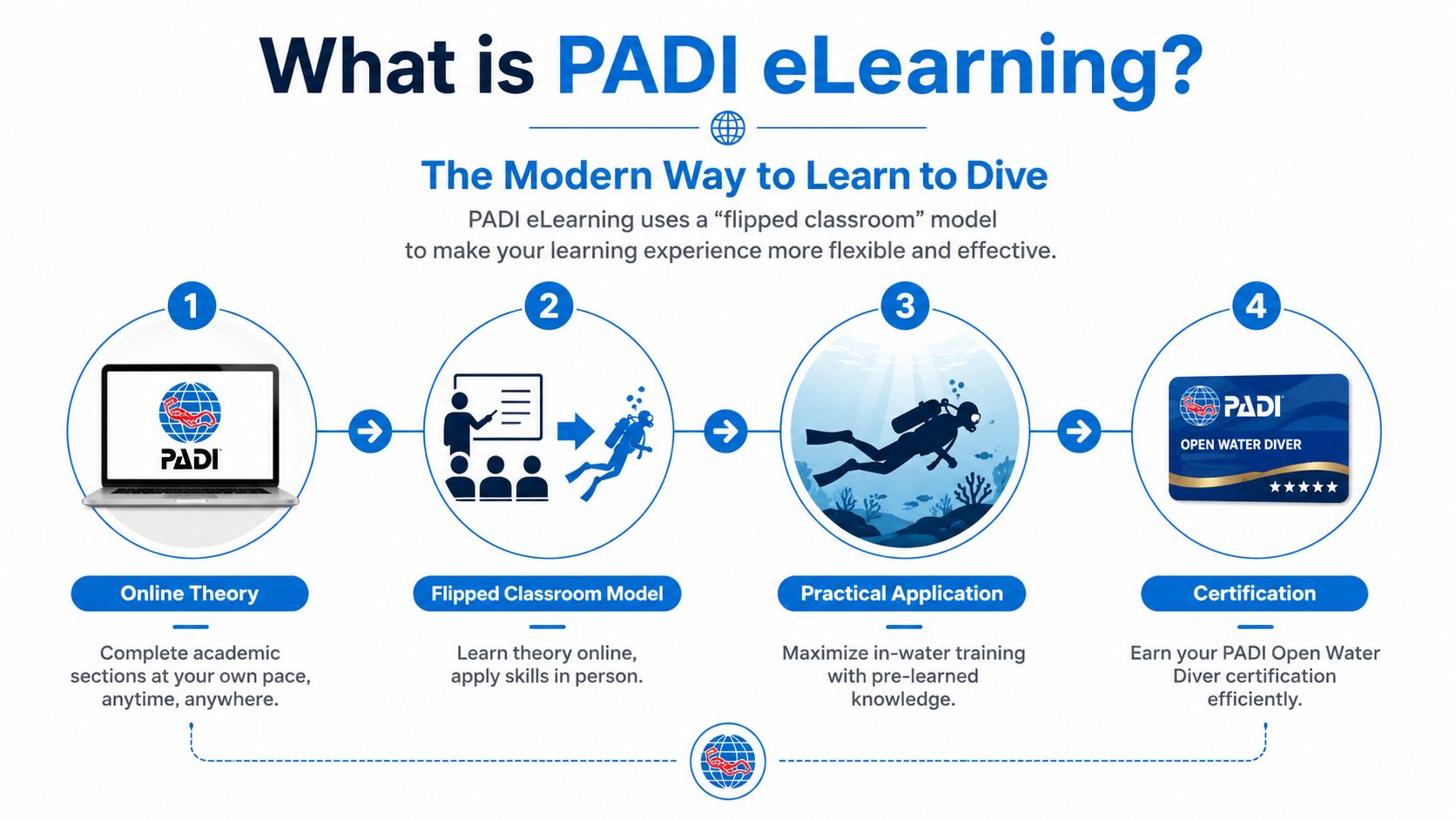
How the flipped classroom model works
Imagine learning a board game before game night. If everyone reads the rules first, game night is for playing. If nobody does, half the evening disappears into explanations.
Scuba works the same way:
- At home you cover principles, terminology, and safety concepts.
- In person you practice mask clearing, regulator recovery, buoyancy work, and other required skills.
- In open water you apply those skills with an instructor supervising the process.
What you actually study online
The online portion isn't a shortcut. It's still the academic foundation for diving. You'll work through learning materials designed to prepare you for real decisions underwater, not just test answers.
That includes topics like:
- Pressure and equalization
- Basic equipment use
- Buoyancy and control
- Safe ascent habits
- Emergency procedures
If you're still deciding whether scuba is the right fit compared with surface exploration, Kona's guide to underwater activities gives a helpful plain-English comparison between snorkeling and scuba.
The best version of a beginner course is one where you arrive knowing the language already, so the instructor can coach your diving instead of translating every term from scratch.
Why this matters for Cozumel
Cozumel is a place where people want water time. PADI Open Water eLearning is valuable here because it respects that. It lets the island be the setting for your practical training instead of the place where you start your reading.
Key Benefits of the PADI eLearning Approach
The biggest benefit is simple. You move study time out of your vacation and into your regular schedule. PADI Open Water Diver eLearning typically requires 10 to 15 hours of online study before confined-water and open-water training, according to this overview of PADI eLearning.
That's a meaningful difference in trip planning. Those hours can happen on your couch, in a coffee shop, or during travel downtime, instead of taking up prime destination time.
Why many travelers prefer it
Some students love classroom learning. Many don't. eLearning works well for travelers because it gives you control over pace and timing.
Here's where it helps most:
| Situation | Traditional classroom timing | eLearning timing |
|---|---|---|
| Busy work week before travel | Little flexibility | Study in short sessions |
| Short vacation window | More time tied up on land | More trip time available for water training |
| Learning style | Group pace | Self-paced review |
| Need to revisit topics | Depends on schedule | Rewatch and reread on your own device |
A lot of the appeal mirrors what people like about other online learning formats. If you've ever taken digital coursework in another field, the convenience will feel familiar. ProMed Certifications' online courses outline similar advantages around flexibility and self-paced study.
The tradeoffs are real
PADI Open Water eLearning isn't better for every personality. It works best when you're willing to finish the modules before the trip instead of pushing them off until the last minute.
The main considerations are practical:
- You need follow-through. If you delay the modules, you don't gain the time-saving benefit.
- You need your device ready. Don't assume airport Wi-Fi or hotel internet will solve everything.
- You need to save your records. Completion matters only if you can present what the dive center needs.
Some students struggle less with the course content than with the logistics around it. The theory is manageable. Forgetting to download materials or save proof of completion is what causes stress.
Who tends to benefit most
In my experience, eLearning is especially useful for:
- Vacation divers who want island days focused on the ocean
- Families or couples trying to coordinate different schedules
- Careful learners who like pausing and reviewing lessons
- Nervous beginners who prefer to absorb concepts privately before getting in the water
If that sounds like you, PADI Open Water eLearning usually feels less rushed and more organized than doing everything after arrival.
Your Step-by-Step eLearning Journey from Home
Starting the digital side is usually easier than people expect. The confusion comes later, when students assume the app, downloads, and completion record will somehow manage themselves. They won't. A little organization upfront makes the whole path smoother.
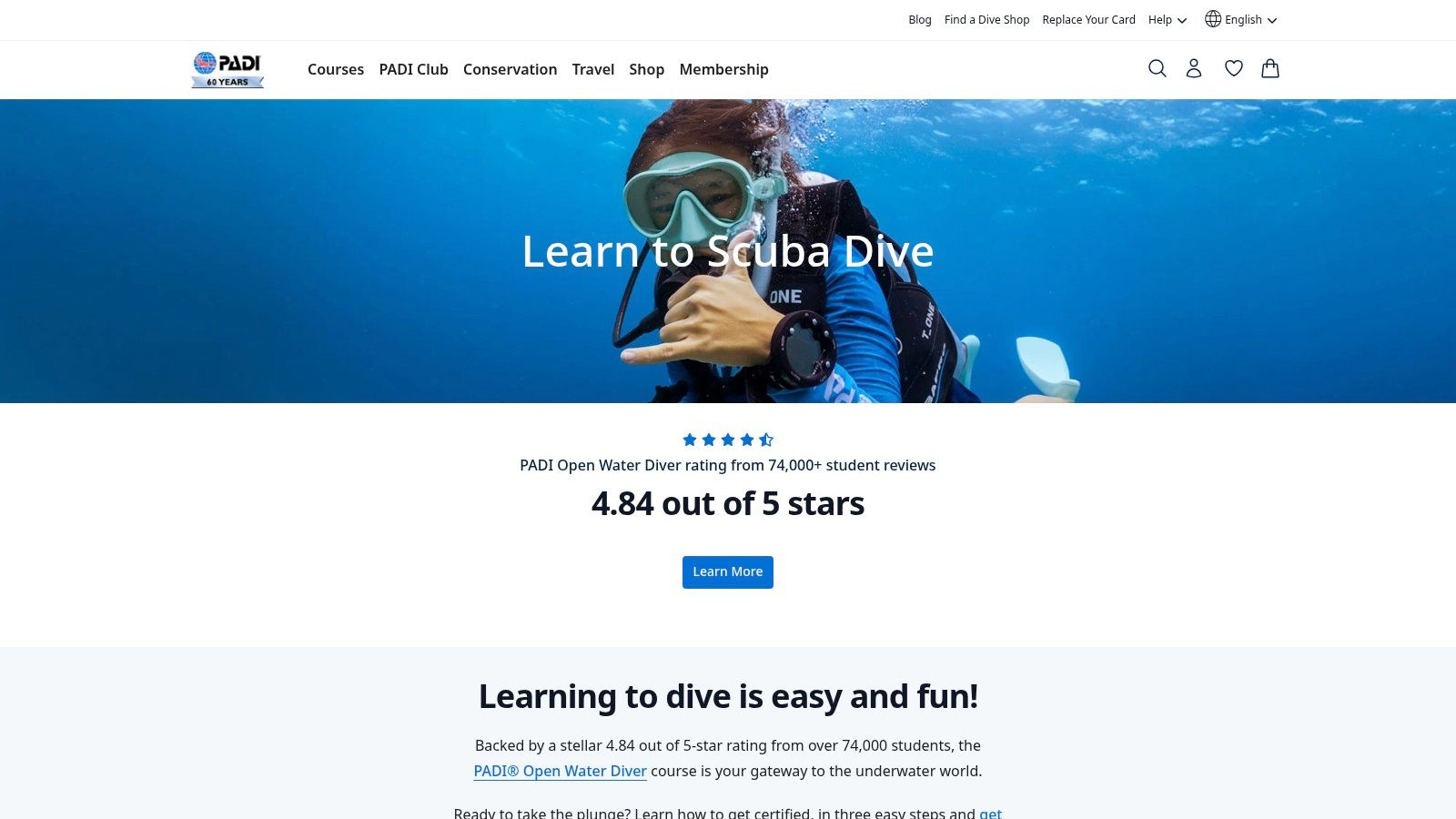
Step 1 Pick the course and create your account
You begin by choosing the PADI Open Water Diver eLearning course and setting up your PADI account. Follow the prompts carefully and make sure the personal information you enter matches the identification details you use for travel.
That sounds minor, but mismatched names create unnecessary check-in friction.
Step 2 Use the PADI Training app correctly
PADI states that the Open Water Diver eLearning module is a prerequisite component completed through the PADI Training app, and that the app is the exclusive place to download and view course materials offline. PADI also notes in its Training app FAQ for Pros that there is no “download all” function, so you need to download individual components one by one.
That matters more than most students expect.
If you're traveling, do this before your trip:
- Open each section manually
- Download the pieces you may want offline
- Confirm they open without internet
- Keep your app updated
- Charge the device you'll bring
Step 3 Work through the lessons in small chunks
The course is modular, which is good news if long study sessions aren't your thing. Most students do better with short, repeatable sessions than one marathon cram day.
A practical rhythm looks like this:
- Read or watch one section.
- Pause and review any term you don't understand.
- Complete the knowledge check.
- Stop before you get mentally saturated.
That approach helps the information stick, which is the whole point.
Step 4 Finish the exam and save your completion record
When you complete the required online components, you need the completion document that shows your progress. Don't rely on memory. Don't rely on airport internet. Save it deliberately.
Bring two versions: a digital copy on your phone and a backup copy you can access quickly if your app won't cooperate.
This short video gives a useful visual overview of the online training flow before you travel.
A simple packing list for the digital side
Before you leave home, make sure you have:
- Your login details
- The PADI Training app installed
- Offline course sections downloaded
- Your completion record saved
- A charger and backup battery if you rely on your phone
This is the part students often treat casually. It's worth treating it like any other dive gear item. If you need it, have it ready before departure.
From Online Theory to In-Water Training in Cozumel
Many guides grow vague at this juncture. They explain the online course well, then skip over the handoff to the practical training. That handoff matters because the online theory does not replace the in-person part. It prepares you for it.
PADI requires students to provide a completion certificate to the dive center before gearing up, and Blue Corner Dive's comparison of eLearning and traditional learning notes that students sometimes arrive with expired or “stale” completion certificates, even though the exact validity window is rarely explained clearly in general content.
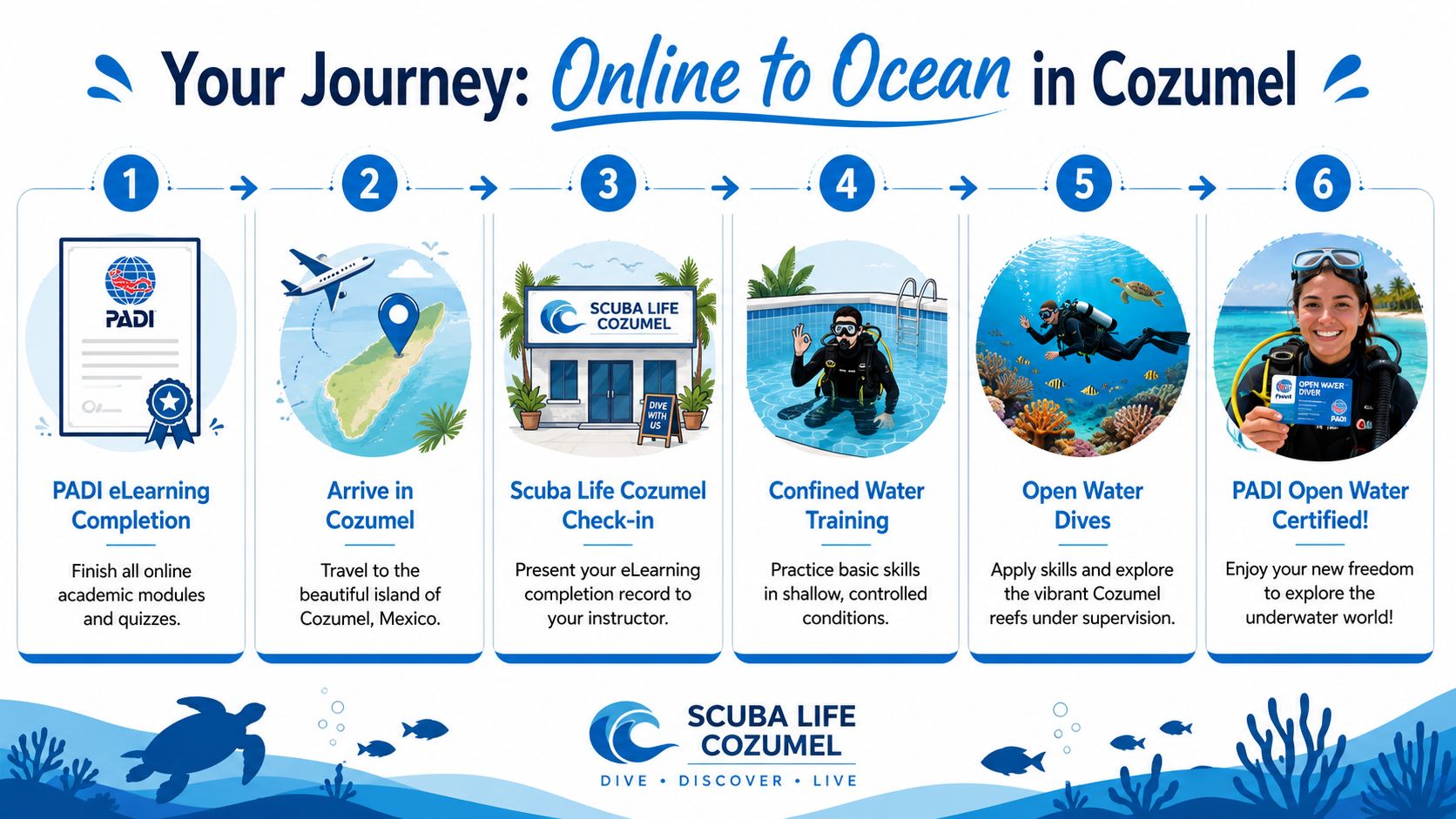
What happens when you arrive
Once you're in Cozumel, your instructor or dive center team checks your course completion record and confirms that your knowledge development is done. Then the schedule shifts fully to practical training.
That usually means a sequence like this:
| Stage | What you do | Why it matters |
|---|---|---|
| Check-in | Present your completion record | Confirms you finished the academic prerequisite |
| Review | Answer any remaining questions | Connects theory to practical use |
| Confined water | Practice core skills in controlled conditions | Builds comfort before open water |
| Open water dives | Demonstrate and apply skills in the ocean | Completes certification requirements |
When to finish your eLearning
This is the part students ask about all the time. Can you do the eLearning now and the dives much later?
Sometimes the answer may be workable in practice, but from a teaching standpoint, I don't recommend treating the online portion as something to finish far in advance and forget. Even when administrative issues don't appear, theory knowledge fades if you leave too much time between online study and the in-water phase.
A better approach is to complete the theory close enough to your trip that the material still feels familiar. You want hand signals, equalization, basic gear terms, and safety concepts to feel recent when you first enter confined water.
Finish the online learning early enough to avoid stress, but not so early that you need to relearn everything on arrival.
What to bring on training days
Your paperwork and digital prep matter just as much as your swimsuit.
Bring these items:
- Your eLearning completion record
- The device with your PADI Training app
- A second accessible copy of your record if possible
- Your swimwear and personal comfort items
- Any required personal medical information
If your training includes boat-based open-water sessions, it also helps to know what that day feels like operationally. Looking over a Cozumel PADI dive boat overview can help first-timers picture the flow from dock to dive site.
Why the bridge matters more than people think
Students often assume the hard part is passing the online material. Usually it isn't. The harder part is arriving organized, current on the theory, and ready to apply it calmly in the water.
That's what makes PADI Open Water eLearning effective in Cozumel. The theory happens at home, but the payoff only shows up when your logistics are clean and your first in-water day starts without scrambling for passwords, documents, or forgotten downloads.
Investment and Inclusions What Your PADI Course Covers
The cost side of certification often causes confusion because people mix two separate parts into one mental bucket. With PADI Open Water eLearning, it helps to think in two layers. First, there's the digital academic portion you purchase through PADI. Second, there's the in-water training portion you complete with the dive operation that handles your practical sessions.
I'm keeping this qualitative because pricing can vary, and no verified pricing figures were provided here. What matters is understanding what each part typically covers so you can ask better questions before you book.
What the eLearning portion pays for
The online component generally covers access to the digital course materials and the official learning path you complete before water training. That includes the academic content, built-in knowledge reviews, and the record of completion you'll need when you continue with practical training.
What you're buying here is preparation and portability. You're paying to move the theory off your vacation calendar.
What the in-water portion usually includes
The in-person side is where your instructor time, practical supervision, and operational logistics come in. Depending on the provider, this often includes items such as:
- Instructor supervision during confined-water and open-water sessions
- Scuba equipment use during training
- Boat logistics for open-water dives when applicable
- Course administration tied to completing the certification process
- Refreshments or day-of support items depending on the operator
The exact list varies, so ask for specifics instead of assuming. “What's included?” is a better question than “What's the price?”
Why the academic side is not optional filler
Some beginners think of the theory as the boring part they need to get through before the fun starts. That mindset causes problems. The academic material is where you build the foundation for buoyancy, pressure awareness, and emergency response.
PADI's discussion of certification rules explains that while Open Water Diver certification trains divers to a maximum depth of 18 meters (60 feet), the eLearning curriculum establishes the foundational theory for buoyancy control, pressure management, and emergency procedures, and that incomplete theory increases the risk of buoyancy-related incidents.
You're not paying for a card. You're paying for a training process that helps you become a safer diver from the first day you breathe underwater.
How to judge value without chasing the lowest price
A low number can look appealing until you realize it excludes key items, rushes the schedule, or leaves you unclear on what happens after the online modules. Better value usually comes from clear communication, organized logistics, maintained equipment, and instruction that doesn't feel hurried.
For a beginner, confidence grows when the operation is predictable. You want to know who checks your paperwork, who handles your practical training, and what support is available if your app or records create friction.
Your Next Steps to Become a Certified Diver in Cozumel
At this point, the process is straightforward. The main thing is doing each step in the right order so your trip stays focused on diving instead of cleanup work.
A simple plan that works
Choose your dates first. Pick travel dates that give you enough time for the practical portion without squeezing every activity into one rushed window.
Buy the PADI Open Water eLearning course. Start early enough that you can complete it comfortably, not in a last-minute panic.
Finish the online material before you travel. Build in a little extra time in case you want to repeat sections or sort out app access.
Save your completion record in more than one place. Your phone is fine. A backup version is smarter.
Reserve your in-water training in advance. Use a direct Cozumel diving reservation page so your practical training dates are arranged before you arrive.
The mindset that makes certification easier
Treat the online portion like part of your gear prep, not an optional homework assignment. If you finish it properly, bring the right documents, and arrive with the material still fresh in your head, the practical days feel much more enjoyable.
That's the efficient version of getting certified. You study on your own time, travel with the admin handled, and use Cozumel for what you came for in the first place.
If you're hesitating
That's normal. Most beginners aren't unsure because they can't learn the material. They're unsure because the process feels unfamiliar.
Once you break it into pieces, it's very manageable. Learn at home. save your record. show up ready. do the skills. enjoy the dives.
Common Questions About PADI Open Water eLearning
How long does the online portion take
PADI Open Water Diver eLearning typically takes 10 to 15 hours for the knowledge development portion, as noted earlier in the article from the cited PADI eLearning overview. Because it's modular, many students spread it over several shorter sessions instead of doing it all at once.
What is the minimum age
The minimum age listed in the verified course information is 12 years old on PADI's learn-to-dive materials referenced earlier in this guide. If you're planning for a younger student or family group, confirm the current course pathway directly before booking.
Do I need to be a strong athlete
No special athletic background is required, but you do need to be medically fit for diving and able to swim. Those are core prerequisites mentioned in the verified course information already referenced above.
Is the certification recognized widely
Yes. The PADI Open Water Diver certification is a globally recognized entry-level certification. It's also described in the verified information as the first scuba certification level that allows independent diving to the course depth limit without a professional guide.
Is the certification valid for life
Yes. The verified data provided for this article states that the certification is valid for life. That said, a lifetime certification isn't the same as lifetime readiness. If you go a long time without diving, a refresher is a smart idea.
Can I finish eLearning now and do the dives later
You may be able to, but students should exercise caution. The provided source material notes confusion around stale or expired completion certificates and says the exact validity window is often not clearly explained in common guides. Even when paperwork is still workable, leaving a long gap can make the knowledge feel rusty when you arrive.
What if I have a medical condition
If you have any medical concern, disclose it early and follow the required process before travel. Don't wait until the morning of training. Medical questions are much easier to resolve when you still have time to gather any needed documentation.
What's the most common avoidable mistake
Forgetting the bridge between online and in-person training. Students often complete the theory, then fail to bring the completion record, don't download app materials properly, or leave such a long gap that they no longer feel confident with the knowledge. Those are all avoidable with a little planning.
If you're ready to turn the online theory into real dives, Scuba Life Cozumel offers PADI training supported by eLearning, along with the in-water instruction, equipment, and local guidance that help new divers finish strong in Cozumel.
Made with the Outrank app